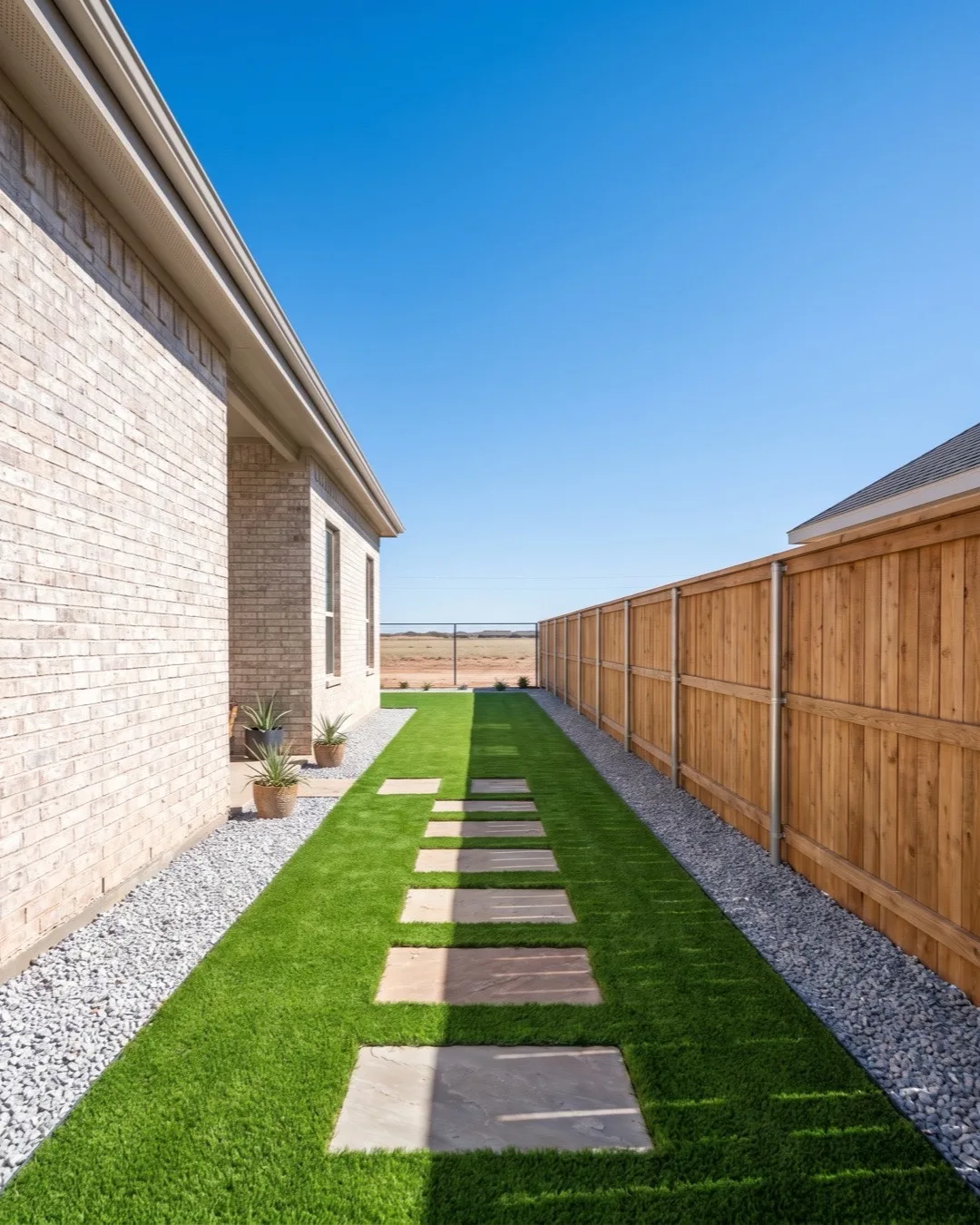
Lubbock Artificial Turf treats an artificial grass job in Post, TX as a planning problem first and a labor problem second, which is fitting for a town that was planned before it was built. C.W. Post founded Post City in 1907 as a utopian colonizing venture, the town incorporated in 1914, and it is still the county seat and the only incorporated municipality in Garza County, with 4,790 residents at the 2020 census in a county of 5,816. It sits at 2,605 feet on the rolling plains at the foot of the Llano Estacado, spread over 9.775 square miles right at the edge of the Caprock Escarpment. Turf here is priced by the square foot off the measured yard, and quotes are free with no obligation.
The setting is the part that actually changes a build sheet. The Caprock rises abruptly above the plains at 200, 500, and in places as much as 1,000 feet, and Garza is one of the counties where it is most prominent. Post is the town that hangs on that edge. Lots roll, water moves fast when it moves at all, and a synthetic lawn on ground like that lives or dies on how the base was graded and compacted, not on which turf roll came off the truck. Post ISD keeps the Antelopes busy, oilfield service work and farming and ranching keep the county busy, and the yards in between get used accordingly.
Old surface removed, grade reset so runoff leaves the lot instead of collecting against the slab, three to four inches of crushed base compacted in lifts, then landscape-grade turf seamed, fastened at every edge and ballasted with infill. On a sloped Post lot the base gets benched into the grade and the turf is fastened at closer spacing so it cannot creep downhill over the years.
Turf Repair Below the Caprock
Separated seams, edges that have lifted out of their fastening, matted lanes where the traffic goes, and low spots that hold water after a hard rain. All of those are repairable when the backing is still sound. What is not repairable is a base that has washed or slumped, and on rolling ground that is worth checking before anyone quotes you a whole new lawn.
Patios, Porches and Concrete Slabs
Turf laid directly over an existing slab, a carport pad or a bare porch, with a drainage layer and pad underneath and edges bonded to the perimeter. It is a common answer for old downtown-adjacent houses where the usable outdoor space is concrete rather than dirt, and it turns a hot gray slab into something the dog and the kids will actually sit on.
A dedicated zone with fully perforated backing over a free-draining base and an odor-controlling infill, sized to the run the dog has already worn into the yard. It can be added to a full conversion later without tearing anything out, because both builds sit on the same base section.
Three Water Sources, and Why That Is Not the Comfort It Sounds Like
The City of Post names three municipal water sources on its own utility page, and the list is unusually candid. White River Municipal Water Authority has supplied the city since the 1960s and, in the city's own words, has been subjected to severe drought conditions in recent years. There is a purchase contract with the City of Slaton. And there is the Southland Well Field, an emergency groundwater field operated by Post and managed by White River, developed jointly by Post, Ralls, Crosbyton and Spur specifically for prolonged drought.
Read that as a homeowner and the picture is clear enough. Three sources is not abundance, it is redundancy built by a town that has needed it. One of those sources is explicitly labeled an emergency supply, and it is shared with three other towns that would be reaching for it in the same dry year. Post also sits below the Caprock rather than up on the plains, so it is not inside High Plains Underground Water Conservation District No. 1 the way the towns north of it are. A lawn that drinks all summer is drawing on a supply the city has already had to shore up twice.
Synthetic turf takes the yard off that ledger completely. No irrigation zone, no timer, no bill that spikes in July, and no green stretch of grass that turns straw-colored the first time a restriction bites. The look does not change between a wet year and a dry one, which in a town with Post's water history is worth more than it sounds.
From Measure to Infill: the Build Sequence on a Post Lot
It starts with a measure and a layout, not a truck. Square footage gets taken off the real yard, obstacles and slope get noted, seam lines get planned so they fall where nobody stands, and the drainage direction gets decided before anything is torn out. On ground that rolls toward the escarpment, that conversation is the job.
Then removal and grading. Live sod and the top couple of inches come out and get hauled off, the subgrade is shaped to carry water away from the house and off the lot, and the fall is checked rather than eyeballed. After that the crushed base goes in and gets compacted in lifts, three to four inches of it, screeded flat. This is the layer that decides whether the lawn is still flat in a decade, and it is also the layer that is easiest for a cheap bid to shave.
Turf goes down last: rolled out, allowed to relax, seamed, fastened around the whole perimeter, then brushed and loaded with infill so the fibers stand up and the surface stays put. Infill type and rate change with what the area is for, more for a pet run, softer for a play zone. Unlike sod there is no grow-in period to wait out before the yard gets used, and the ongoing maintenance is a stiff broom, not a mower and a sprinkler controller.
The bid should name the base. Depth, material, and the fact that it was compacted in lifts. On rolling Caprock-edge ground this is the line item that separates a lawn that drains from a lawn that ripples, and it is the first thing a low bid quietly drops.
The bid should name the turf. Face weight, pile height, backing type and whether it is fully perforated. It should also say what infill goes down and at what rate, because a pet zone and a front yard should not be getting the same answer. Ask what the warranty covers on the material and, separately, on the workmanship, since those are two different promises.
The bid should be measured, not estimated. A real square footage taken at the property, a per-square-foot price, demolition and haul-off stated as their own line, and any hand-work premium for hard access spelled out rather than discovered later. Anything vague enough to be re-interpreted mid-job usually will be. Getting a quote in Post costs nothing and carries no obligation, so there is no reason to accept a number written on the back of a card.
One more thing worth deciding before you sign anything: whether the yard in question is a good candidate at all. A shaded strip that nobody walks on and never gets watered may not need touching. The strongest turf projects are the ones where the grass is losing anyway, which in a town with Post's water record is most of them.
Published national cost ranges put installed artificial turf at roughly $5 to $20 per square foot, with most residential lawns falling between $8 and $14, so a 500-square-foot yard commonly lands somewhere around $4,000 to $7,000. Pet zones, play areas and turf over concrete tend to run in the $10 to $18 band because of the padding, drainage layer or specialty infill they need. Those are ranges published nationally, not a quote for your property, and they are printed here so you can measure any bid, ours included, against something.
Repairs are a different animal and should be priced that way, by the scope of the fix rather than by the whole yard. Reseaming a split, refastening a lifted edge, or opening up and rebuilding a low spot that ponds are all far cheaper than replacement when the backing is still good. The variables that move a full install are the ones you can see from the driveway: how much old lawn comes out, how the slope has to be reworked, how easily a machine reaches the back yard, and which turf grade the space actually calls for.
Working Out Whether It Pays on Your Lot
The honest version of the cost question is not what turf costs per foot, it is what the yard is costing you now and how much of it you actually use. Square footage, water use, the hours the mower eats, and whether the grass was ever going to win in this climate all belong in that comparison. In a town whose own utility page describes its main reservoir as subjected to severe drought conditions in recent years, that arithmetic tends to lean one direction, but it is worth running before you spend anything.
No. Post sits on the service map along with the rest of the towns south and east of Lubbock, and it is quoted on the same terms as any other address, for a full lawn or for a repair visit. Quotes are free and there is no obligation.
Does being at the edge of the Caprock change how turf gets installed?
It changes the base work more than the turf. The Caprock Escarpment rises abruptly above the plains and Garza County is one of the places it is most prominent, so lots here can carry real slope. The subgrade gets benched and compacted on the grade, drainage is routed past the yard rather than through it, and the turf is fastened at closer spacing so gravity cannot pull it downhill.
Post's water comes partly from an emergency well field. Does turf actually help?
It removes the yard from the demand side entirely. The city lists White River Municipal Water Authority, a purchase contract with Slaton, and the Southland Well Field, which was built as an emergency supply shared with Ralls, Crosbyton and Spur. Turf needs no irrigation zone at all, so a dry summer costs the household nothing extra and the lawn looks identical either way.
Can you put turf over an old concrete slab or porch?
Yes, and on older properties it is often the better use of the space. A drainage layer and pad go over the slab, the turf is bonded at the perimeter, and water still gets out through the perforated backing. It reads as lawn, it is cooler and softer than bare concrete underfoot, and it does not require breaking up the slab first.
Get a Free Turf Quote in Post
Tell us what the yard looks like now and you get a call back with a real number. The quote is free and there is no obligation.