
Lubbock Artificial Turf
Menu

Free quotes · The version with the bad parts left in

Is Artificial Turf Worth It in Lubbock, TX? The Honest Pros and Cons

Lubbock Artificial Turf installs artificial grass for a living, so read this page knowing that. It is still the version with the bad parts left in, because turf is right for a lot of yards here and wrong for some, and you are better off knowing which one you have before anybody measures anything. Quotes are free and there is no obligation, including the quote you decide not to take.

Here is the case Lubbock itself makes. The city sits in a cool semi-arid climate and averages 18.33 inches of rain a year, logs 92 days at 90°F or hotter and about 13 days over 100°F, and holds outdoor watering to two days a week by house number, no Sundays, April through September, with midday watering prohibited. Bermuda goes dormant after the first freeze, which arrives around November 11, and does not green up again until late March or April, so a natural lawn here is tan for roughly five months a year. Water rates are tiered to penalize heavy irrigation, and the city floated an increase on August 5, 2026. There is no city turf rebate, and we are not going to invent one.

None of that makes turf automatic. It has real drawbacks, and the ones that matter are not always the ones argued about online. What follows is the honest limits first, then the honest case for it, then how to work out which side of the line your own yard falls on.

Wondering how this would work at your place? Call (806) 630-0409 or get a free quote.

Is Artificial Turf Worth It? The Drawbacks, Listed First

It gets hotter than natural grass in direct sun

This is true and there is no way around it. Turf in full afternoon sun runs warmer than a watered lawn, the same way a patio slab or a wood deck does, and in a city with 92 days a year at 90°F or above you will notice it. What helps is simple: a hose rinse drops the surface temperature fast, lighter fiber colors run cooler than dark ones, and any shade at all, a tree, a sail, the north side of the house, changes the number completely. What does not help is pretending it never happens. If the one area you want turfed has no shade and bare feet are the whole point, say that out loud before you buy.
The up-front cost is several times what sod costs

Turf is paid for once, in full, at the beginning. Sod is cheap to buy and expensive to keep alive. That trade only works if you stay in the house long enough for the second half to matter, and we will not hand you a payback year, because we cannot verify one for your address. Lubbock has no turf rebate to soften it either. If the up-front number is a stretch this year, converting one area now and the rest later is a real option, and a better one than a thin install.

A bad base ruins it, and you cannot see the base after install day

Nearly every turf failure is a base failure: rock spread too shallow, no compaction in lifts, or grading that does not fall away from the house. It shows up two summers later as dips, ripples, and water sitting where it should not. The hard part is that the moment the turf goes down, the evidence disappears under it for good. That is why the questions worth asking are about inches of base and compaction in lifts, not about blade color.

It is plastic, and one day it comes out

Synthetic turf is a manufactured product with a service life, not a permanent surface. Fibers eventually mat and fade, fastest on south and west exposures, and at some point the answer is replacement rather than repair. Manufacturer ratings vary widely from product to product, and in practice the base underneath and the traffic on top decide more than the spec sheet does. Anyone answering this with one confident number of years is guessing at your yard.

Want the square footage measured and priced? Call (806) 630-0409 or get a free quote.

Who Should Buy Turf, and Who Should Not

The fit question is more useful than the pros-and-cons question. Two of these are a yes, two are a no.

Yes: the parts of the yard that lose no matter what you do

Side strips with no airflow, the shaded run along a fence, the path the dog wore in, the hell strip by the driveway. These areas fail under any watering schedule, and under two days a week from April through September they fail faster. Ground that thin is also where stickers move in; goatheads and sandburs are documented invasive problem plants here per Texas A&M AgriLife, and they need bare soil to work with. Turf gives them none.

Yes: households where the yard has an actual job

Dogs that need somewhere to go, kids who need somewhere to land, a green you want to putt on in February. When a yard is a surface people use rather than a plant you tend, turf is usually the better product. It stays the same in a drought, through a watering restriction, and after the first freeze around November 11.

No: you genuinely enjoy taking care of a lawn

Some people like Saturday morning with a mower. They like the smell, the stripes, the fact that it is a living thing responding to what they do. Turf takes the hobby away and hands back a surface. If that describes you, this is a bad purchase and we would rather say so now than after you have written the check. Turf does not miss you; you might miss the lawn.

No: the yard is not what is bothering you, or you are leaving soon

If the real complaint is drainage, a dead tree, or a fence, turf will not fix it, and a yard that ponds today has to be regraded before turf goes anywhere near it. And we cannot tell you what turf returns at resale, so we are not going to pretend to. If you are moving in the near term, that unknown is a reason to wait, not a reason to buy.

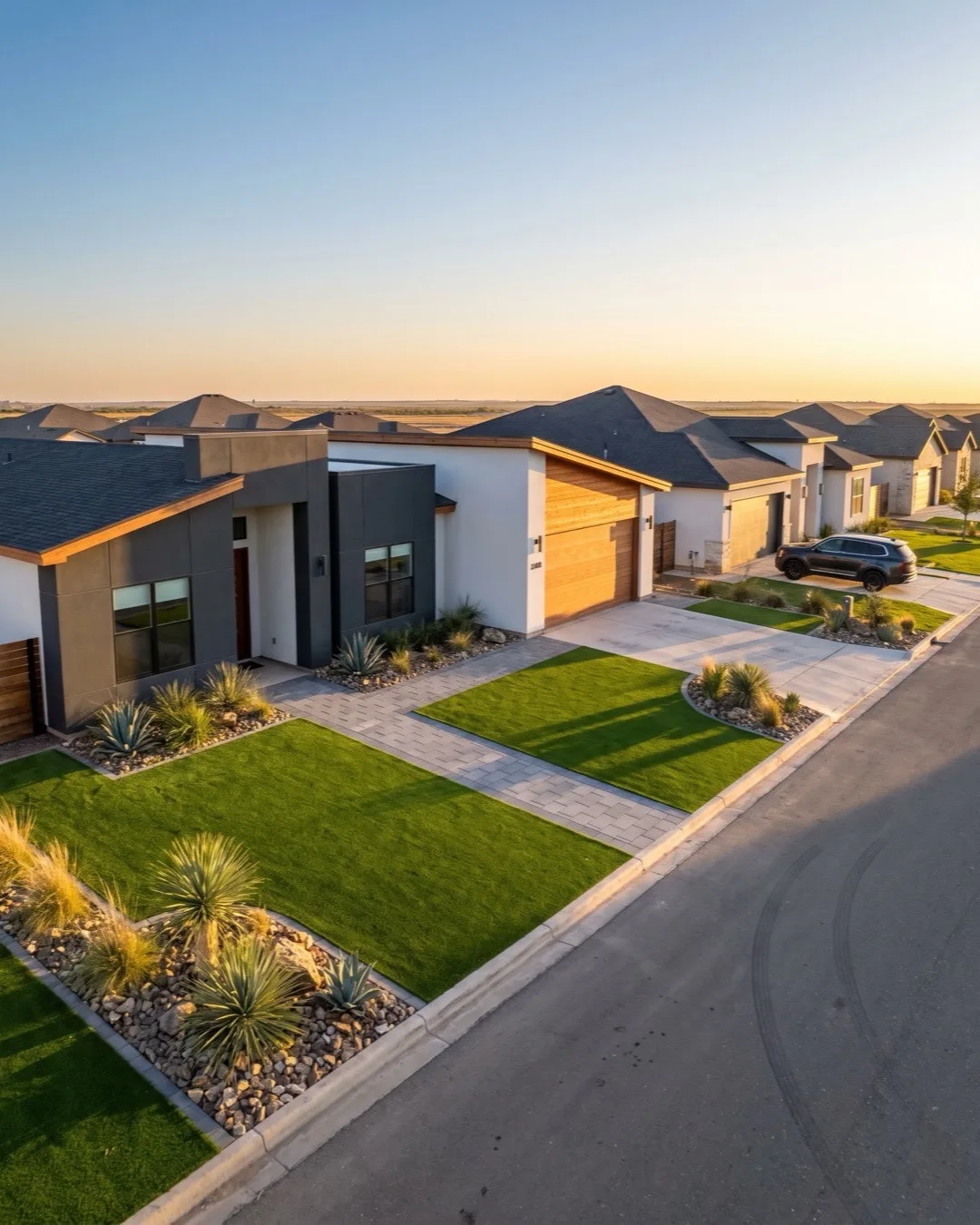
Artificial turf front lawn beside a concrete walkway and white brick home

Thinking about this part of the yard? Call (806) 630-0409 or get a free quote.

How to Decide Without Talking to a Salesperson

Five steps, none of which need a company standing in your yard. Do them first and the quote conversation gets a lot shorter.

  1. 1

    Walk the yard and mark what is actually failing

    Not the whole lawn, the specific spots. Bare paths, the strip that never fills in, the corner that ponds, the patch the dog has claimed. Plenty of people find the real problem is a fraction of the yard rather than all of it.

  2. 2

    Measure only the area you would really convert

    Pace it or tape it and write down the square footage. Turf is priced by the square foot, so this one number turns every published range on the internet into a rough figure for your house instead of somebody else's.

  3. 3

    Add up what that area costs you right now

    Water, mowing, reseeding, fertilizer, sticker treatment, and the hours. Use your own bills, not a number from a company website. We will not do this math for you on a web page because we would have to invent the inputs.

  4. 4

    Ask base questions before you ask price questions

    How many inches of crushed base, compacted in lifts or not, what backing, what infill and at what rate, and how the perimeter is fastened. In the 10th-windiest city in the country, at an average 12.4 miles per hour, the edge detail is not a footnote. Bids that dodge these questions are cheap for a reason.

  5. 5

    Start with one area, not the whole property

    A dog run, a side yard, or a front strip is a small enough commitment to live with for a season before deciding about the rest. Plenty of turf yards were built in two visits a year apart, and nothing about that is a worse install.

The Money Part, Without a Payback Promise

Published national cost guides such as Angi and HomeGuide put installed artificial turf at roughly $5 to $20 per square foot, with most residential lawns landing between $8 and $14 and pet systems higher at about $10 to $18. At the middle of the lawn band, a typical 500-square-foot yard works out to roughly $4,000 to $9,000 installed. Those are published national ranges, not a quote for your yard, and they are on this page so you can hold any bid up against them, ours included.

What we will not do is turn that into a payback year for you. We do not know your water rates, your square footage, how long you are staying, or what you currently spend on mowing and reseeding, and any company printing a savings figure without those things made it up. The direction is not a mystery: Lubbock's rates are tiered to penalize heavy irrigation, the city floated an increase on August 5, 2026, and the city leans on the Ogallala Aquifer, which is being drawn down at an unsustainable rate. Run the arithmetic with your own bills in front of you and decide from that.

See the full turf cost table

Wondering what your yard would cost?

Call for a free quote. If the price doesn't work, that's the end of it — no follow-up calls.

(806) 630-0409

Is Artificial Turf Worth It? FAQs

Does artificial grass get hot?

Yes, hotter than a watered natural lawn in direct sun. It behaves like other outdoor surfaces: it heats up in full afternoon sun and cools off quickly in shade or after a rinse. In a city that logs about 13 days a year over 100°F, that is worth planning around rather than arguing about. Lighter fiber colors, shade over the area, and a hose all help. Full-sun turf under bare feet at four in the afternoon in July will be warm, and no product claim changes that.

How long does artificial turf last?

Manufacturer service-life ratings vary a lot between products, so the useful answer is what actually decides it: the base underneath, the traffic on top, sun exposure, and whether the infill gets topped up. A properly built base commonly outlasts the turf sitting on it. A shaded, lightly used lawn and a full-sun dog run on the same product will not age the same way, which is why a single confident number from someone who has not seen your yard is worth very little.

What are the most common artificial grass problems?

Roughly in order: a base built too thin or not compacted in lifts, which shows as dips and ponding; seams opening because they were set on failing tape or starved of adhesive; edges lifting because the perimeter was pinned too sparsely; matted fibers where infill has settled below the blade line; pet odor from plain silica infill; and fading on south and west exposures from fiber that was not UV-stabilized. Five of those six are installation decisions, not product defects.

Do weeds grow in artificial turf?

Not up through a properly built install, but they do sprout in it. Windblown seed lands in the infill and along the perimeter, and Lubbock is the 10th-windiest city in the United States at an average 12.4 miles per hour, so seed arrives. What grows there is shallow-rooted and pulls out with your fingers, but it does need pulling or spot-treating a few times a year. Edges and the seams against planting beds are where you will see it first.

Is turf worth it if I have dogs?

For most dog owners here, yes, with one condition attached. A pet area needs a real routine: pick up solids, rinse the zone with a hose, and use an enzyme treatment in hot weather. Skip that and it will smell, especially on plain silica infill, which stores urine instead of passing it through. Built on flow-through backing with zeolite or antimicrobial infill and rinsed on a schedule, a dog yard stays fine. The honest version is that turf moves the work, it does not delete it.

The money half of this decision is broken down in how turf pricing actually works.

Free Quote, and a Straight Answer If Turf Is Wrong for You

Tell us which part of the yard you are thinking about and you get a call back with a real number. If turf is a poor fit for what you described, you will hear that instead. Free either way, no obligation.

Call (806) 630-0409