Lubbock Artificial Turf
Menu

Free quotes · Quoted from a site walk

Commercial Artificial Turf in Lubbock, TX: Multifamily, Office, HOA and Patio Installs

Lubbock Artificial Turf installs commercial artificial turf for apartment communities, office and retail frontages, HOA common ground, restaurant and bar patios, daycares and schools, and the courtyards, medians, and hardscape strips in between. The discipline is the same as a residential yard, base, drainage, seams, and edges, carried out at a scale where the surface gets walked all day and the property cannot close while the work happens.

The local math is the same as a homeowner's, just multiplied. Lubbock holds outdoor watering to two days a week by house number, no Sundays and no midday watering, April through September, on an average of 18.33 inches of rain a year. A leasing courtyard or a restaurant patio does not get to look brown for those months. There is an enforcement side as well: the city's ordinance requires grass and weeds be kept under eight inches, and a property that falls behind can pick up a $200 administrative fee. Turf takes both problems off the property manager's list.

What changes at commercial scale is load and logistics. Traffic that would be a worn path in a back yard becomes a visible line through a leasing courtyard in one season, so face weight goes up and infill goes in heavier. Drainage has to be solved across a whole property rather than one yard, which usually means the base carries fall to more than one exit. And the install gets planned in phases, because the patio, the dog park, and the front door all have to keep working while the crew is there.

Ready to put a number on it? Call (806) 630-0409 or get a free quote.

What Changes on a Commercial Artificial Turf Job

Heavier face weight for real traffic

Face weight is ounces of yarn per square yard, and it is the number that tracks how long a surface resists matting. A courtyard crossed a few hundred times a day is not a back lawn. Commercial areas get a denser, heavier turf with a blade shape that stands back up, spec'd by the path, not by the whole property at one grade.

Drainage planned across the whole site

One yard drains to one place. A property drains to several, and the areas in between are usually hardscape that already sheds water somewhere. The base gets graded to carry water to the existing exits, and where a low area ponds today, that gets corrected or drained before turf goes over it, quoted as its own line.

Phased installation so the property stays open

Work is broken into sections with a sequence agreed before it starts: which walkway stays open, where the base rock stages, where the crew parks. Occupied multifamily and operating restaurants usually get the sections closed and reopened one at a time rather than the whole area fenced at once.

Surface transitions built flush

Where turf meets a walk, a curb, a threshold, or a drain, the finished surface is built to sit flush rather than proud, so there is no lip at the joint. Turf over a properly compacted base with a short dense pile gives a firm, stable surface. We are not a code consultant, so accessibility requirements get confirmed with your architect or the city and we build to the detail the plans call for.

Wondering how this would work at your place? Call (806) 630-0409 or get a free quote.

Which Properties Use Commercial Artificial Turf

Four property types account for most commercial turf around Lubbock. Each one weights the spec differently.

Apartments & Multifamily Common Areas

Courtyards, entry medians, pool decks, and on-site dog parks. The dog park is the piece that most often gets built wrong: it needs the pet system, flow-through backing and zeolite or antimicrobial infill over a base with no low spots, not the same roll used at the leasing office.

Office, Retail & Restaurant Frontages

Street-facing beds, patio floors, courtyards, and rooftop decks. A frontage stays green straight through a watering restriction that would brown out sod, and a patio floor gets a spec that stands up to chairs dragged across it every night.

HOA Common Ground, Medians & Hardscape Strips

Entry monuments, detention slopes, and the narrow strips between curb and walk that no irrigation zone ever covered properly. These are small areas spread across a property, so the quote depends on access and mobilization as much as on square footage.

Daycares, Schools & Play Areas

Play surfaces get a shock-absorbing foam pad under a softer, taller fiber, plus turf on the strips that get walked bare by the end of a school year. Padding depth is spec'd against the fall height of the equipment on your plans.

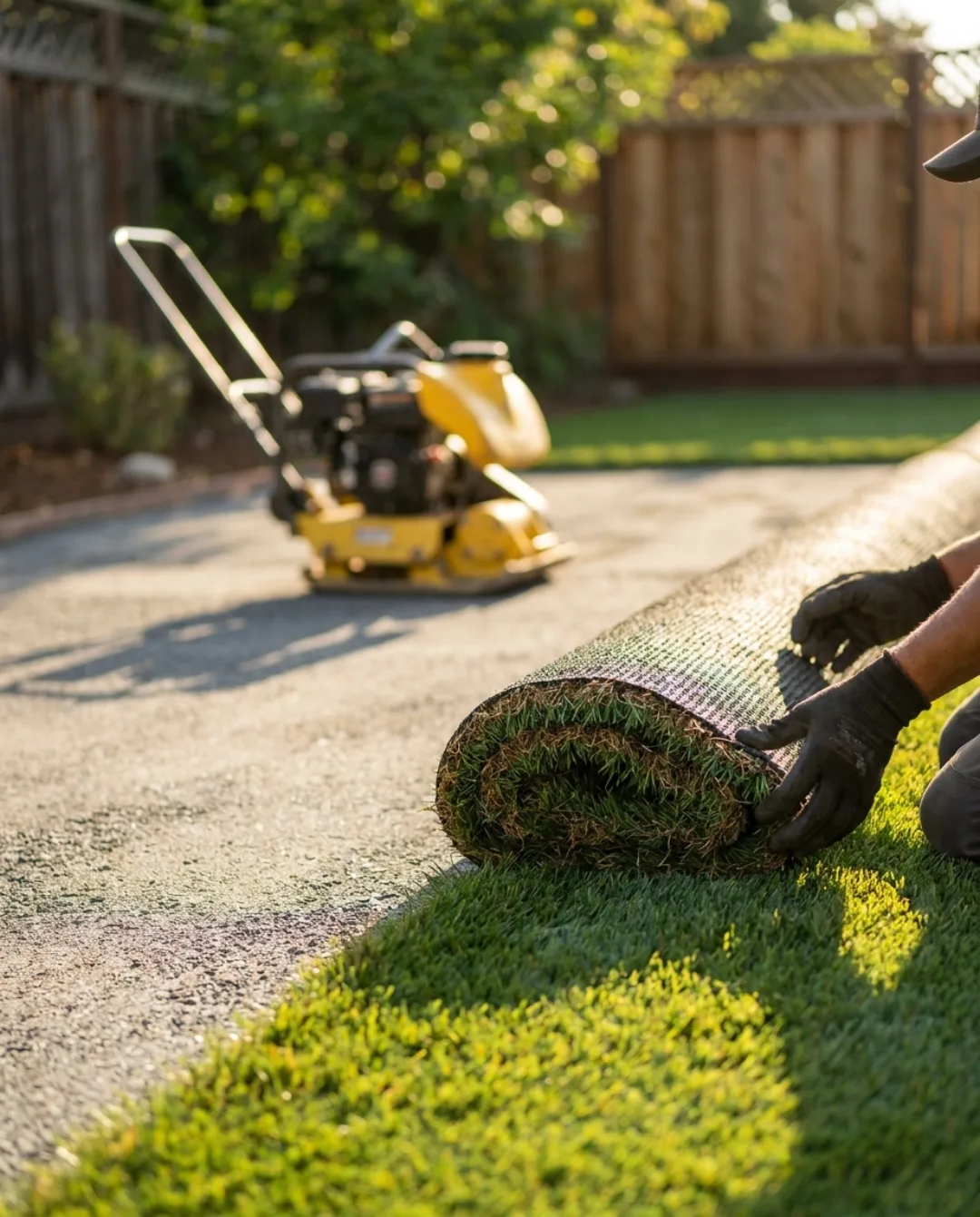
Artificial turf being rolled out over a compacted base during installation

Want the square footage measured and priced? Call (806) 630-0409 or get a free quote.

How a Commercial Turf Project Is Phased

Commercial work follows the same five steps as a yard, with the schedule built around the property rather than the crew.

  1. 1

    Site walk and measurement

    Someone walks the property with a wheel and a plan: every area, the traffic lines through it, where water goes today, gate and lift access, and what the surface ties into at each edge. This is why commercial numbers come from a walk and not a phone call.

  2. 2

    Spec, submittal and sequence

    Turf product, face weight, backing, pad where required, infill type and rate, base depth, and the section-by-section sequence, all named in writing before mobilization. Phasing gets agreed with the property here, not improvised on day one.

  3. 3

    Demolition, base and grading, by section

    Section by section: existing surface out, crushed base in, wetted and compacted in lifts, graded to the drainage exits identified on the walk. Each section is closed, built, and reopened before the next one starts.

  4. 4

    Turf layout, seaming and edge fastening

    Rolls are relaxed, laid with the grain one direction across the whole property so adjacent areas match, seamed on tape and adhesive, and fastened at close spacing to nailer boards, bender board, or bonded where the edge meets hardscape.

  5. 5

    Infill, brooming, punch walk and handoff

    Infill is broomed in at the specified rate, the site is blown clean, and every edge and seam gets walked with your representative. The handoff includes the maintenance routine and the infill top-off interval, so it can go on a property calendar.

What Commercial Artificial Turf Costs in Lubbock

Published national cost guides such as Angi and HomeGuide put installed artificial turf at roughly $5 to $20 per square foot, with most residential lawns between $8 and $14 and a typical 500-square-foot yard around $4,000 to $9,000. Those are published national ranges for residential work, and they are printed here so you have a reference point rather than a figure pulled out of the air.

They do not price a commercial project, and we will not pretend otherwise. Face weight, phasing, drainage across a large area, tie-ins to walks and curbs, padding under play equipment, and after-hours work all move a commercial number in ways a residential cost guide never measures. Commercial turf is quoted from a site walk or from plans. The walk and the quote are free, and there is no obligation.

See the full turf cost table

Wondering what your yard would cost?

Call for a free quote. If the price doesn't work, that's the end of it — no follow-up calls.

(806) 630-0409

Commercial Artificial Turf FAQs

Why can't you quote commercial turf over the phone?

Because the two things that move the number most cannot be seen from a phone call: what is under the existing surface, and where water goes. Add access for equipment and materials, tie-ins at every edge, and the phasing the property needs, and a phone figure would be a guess. The site walk is free and there is no obligation attached to it.

Can the property stay open during installation?

Usually, yes, by working in sections. One area is closed, demoed, based, turfed, and reopened before the next one starts, with the sequence agreed before mobilization. It takes longer overall than fencing everything at once, and that tradeoff is worth naming up front rather than discovering mid-job.

What turf spec does a commercial area need?

Heavier and denser than residential, with UV-stabilized fiber, and different by area within the same property. A leasing courtyard, a restaurant patio, a dog park, and a daycare play area are four different specs. Any bid should name pile height, face weight, backing, infill type and rate, and base depth for each area separately.

Is artificial turf an accessible surface?

Turf over a properly compacted base, with a short dense pile, full infill, and transitions built flush to adjoining walks, gives a firm and stable surface with no lip at the joint. Whether a given installation meets the accessibility requirements for your project is a determination for your architect and the authority having jurisdiction, not for us. We build to the detail your plans specify.

What maintenance should we budget for?

Blowing debris off, power brooming the traffic lines once or twice a year, topping off settled infill every few years, rinsing pet areas on a regular interval, and an annual look at seams and perimeter fastening. No mowing, no irrigation, no fertilizer. We hand over the routine and the intervals at the punch walk so it can go on your calendar.

Commercial numbers start from the same per-square-foot logic as residential, so see how turf pricing is built.

Get a Free Commercial Artificial Turf Quote in Lubbock

Tell us the property, the areas you are thinking about, and the rough square footage. We set up a site walk and come back with a real number. Free, no obligation.

Call (806) 630-0409