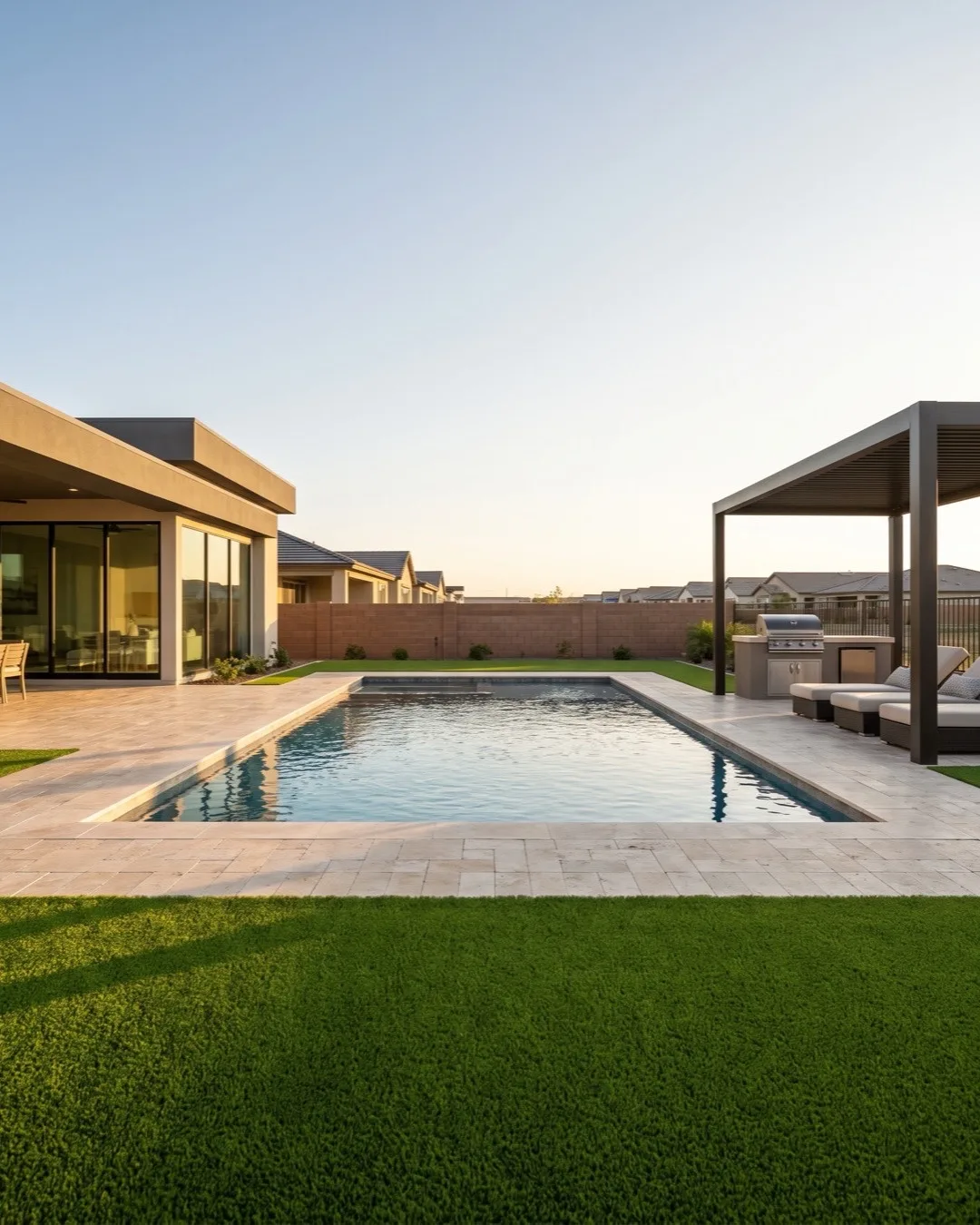
Lubbock Artificial Turf installs artificial grass on concrete: patios, porches, balconies, rooftop decks, pool decks, garage floors, and old slabs nobody has known what to do with. There is no digging on this job and no base rock. The slab is the base, which means the whole install turns on two questions, whether the surface is sound and where the water goes. Quotes are free and there is no obligation.
Lubbock gives a slab a hard time. The city logs 92 days a year with highs of 90°F or above and 13.3 days over 100°F, and the record high here is 114°F, so a bare patio in full afternoon sun is not somewhere anyone sits. Rain averages 18.33 inches a year, and when it comes the concrete is the only thing moving it, so the fall the slab was poured with decides the whole build. Then there is the wind. This is the tenth-windiest city in the United States at an average 12.4 miles per hour, and on concrete there is nothing to drive a spike into, so the perimeter has to be bonded and bonded properly.
Be honest about what turf over concrete is and is not. It changes how a hard surface looks and, with a pad under it, how it feels underfoot. It still warms up in direct sun the way any surface does. And it does not add drainage that the slab never had. A patio that holds water today will hold it under turf, which is something worth hearing before the work starts rather than after.
What Makes Artificial Grass on Concrete a Different Build
No excavation, no base rock
Everything a compacted base normally does, support the surface and carry water away, the slab either already does or does not do. So the job starts with a level, a straightedge, and a hose rather than a shovel. What we find in that first hour sets the entire scope.
Drainage borrowed from the slab's own fall
Water passes through the turf backing and then has to go somewhere. A patio poured with fall to the yard handles it on its own. A flat slab or a balcony with a single scupper needs a drainage underlayment, a pad with channels molded into its underside, to move water sideways to that one low point. Where there is no fall and no drain at all, we say so before quoting.
Bonded edges instead of spikes
There is nothing to fasten into, so the perimeter is bonded with an outdoor turf adhesive, trapped under trim or a paver band, or both. Full-spread adhesive goes down where wind, splash, or a balcony calls for it. A perimeter-only bond is the right call where the slab may need to come back to bare concrete someday.
Padding underfoot, clean cuts around obstacles
Concrete stays concrete underfoot unless something goes between, and a foam pad is what softens the surface and hides a broom finish or minor slab texture. Post bases, downspouts, deck drains, and scuppers get cut around and finished tight rather than covered, because a covered drain stops being a drain.
Four surfaces cover most slab jobs. The build is the same in outline; the drainage answer and the fastening method change with each.
Patios, Porches & Old Back-Yard Slabs
The most common version, and usually the easiest, because a patio was normally poured with fall away from the house. Old slabs with cracks, spalling, or a decade of flaking sealer need cleaning and patching first, since anything left proud telegraphs through the turf.
Balconies & Rooftop Decks
Weight is the constraint here, and infill is nearly all of it. Balcony installs usually run pad and turf with light infill or none, bonded at the perimeter, and drainage routed to the existing scupper. Building rules and HOA approval get sorted before anything goes down, not after.
Pool Decks & Splash Zones
Constant splash-out, chlorinated water, and bare feet. These get a full-spread bond so nothing lifts when it is wet, a drainage pad where the deck is flat, and edges run tight to the coping or the paver band.
Garage Floors & Interior Slabs
Gyms, shops, hobby rooms, and putting areas. There is no drainage on these at all, so nothing wet goes on them, and slab moisture gets checked during prep. A bonded or trim-trapped edge keeps corners from curling where a door sweeps.
Five steps, and the first two are almost the whole job on a hard surface.
1
Read the slab
Where does water go today, tested with a hose rather than assumed. Cracks, spalling, unsound patches, and how far off level the surface sits all get recorded. This is the step that tells us whether a drainage pad is needed or the slab's own fall is enough.
2
Clean, patch and level
Pressure wash, strip flaking sealer, paint, and old adhesive, patch spalled areas, grind high spots, and fill dips with a leveling compound. Concrete needs to be clean and dry for any adhesive to hold, so this step is not optional on a bonded install.
3
Pad or drainage underlayment down
A comfort pad where the slab already drains, a channelled drainage pad where water has to travel sideways to a scupper or a single low point. The pad is cut to the perimeter and around every drain and post base before turf goes over it.
4
Turf cut, seamed and bonded
Rolls relax in the sun, then get cut to the perimeter and scribed around posts, columns, and drains. Seams close on tape and adhesive with the grain one direction. The edge is bonded, trapped under trim or a paver band, or both, depending on the exposure.
5
Infill, broom and edge check
Infill rate depends on the surface: full rate on a patio, light or none on a balcony where weight matters. It is broomed in to stand the blades up, the area is blown clean, and every edge and every cut around a drain gets walked before the crew leaves.
How Much Does Artificial Grass on Concrete Cost in Lubbock?
Published national cost guides such as Angi and HomeGuide put installed artificial turf at about $5 to $20 per square foot, with most residential lawns between $8 and $14, which puts a typical 500-square-foot yard around $4,000 to $7,000. Those are published national ranges for turf work generally, not a quote, and a slab install is not the job they describe.
The line items move. A concrete job skips excavation, haul-off, and base rock, and it adds slab prep, a pad or drainage underlayment, and adhesive. Slab areas also tend to be small, and small areas price higher per square foot than large ones because setup costs about the same either way. The only way to get a real number is to measure the surface and watch where the water goes.
Water goes through the turf backing easily. What happens next is up to the slab. A patio poured with fall drains on its own. A flat slab needs a channelled drainage pad to move water sideways to a low point or a drain. A slab with no fall and no drain will hold water under the turf, and we will tell you that before quoting rather than after installing.
Do you glue the turf down, or just fasten the edges?
Both methods are used, for different reasons. A full-spread adhesive bond goes down on balconies, pool decks, and anywhere wind or splash will work at the surface. A perimeter-only bond, with the field held by infill weight, is the choice on a patio you may want to return to bare concrete one day. We name which one is in the quote.
Can I get my patio back later?
A perimeter-only install comes up cleanly. A full-spread adhesive install leaves residue that has to be ground or scraped off the slab, which is real work and real cost. That is exactly why the fastening method is worth deciding at the quote, based on how permanent you want it to be.
Will turf work on an apartment balcony?
Often, with two checks first. Weight is one: turf and pad are light, but infill is not, so balcony installs usually run light infill or none and rely on a bonded perimeter. Permission is the other. Your lease, building rules, or HOA may have something to say about what goes on the balcony and how it attaches, and that gets settled before anything is cut.
Does the slab need cleaning or leveling first?
Cleaning, always. Adhesive does not bond to dust, flaking sealer, old paint, or a damp surface. Leveling, only where it is needed: high spots get ground, dips get filled, and spalled areas get patched. A badly cracked or heaving slab is a different conversation, because turf covers a bad slab without fixing it, and the surface will show what is under it.