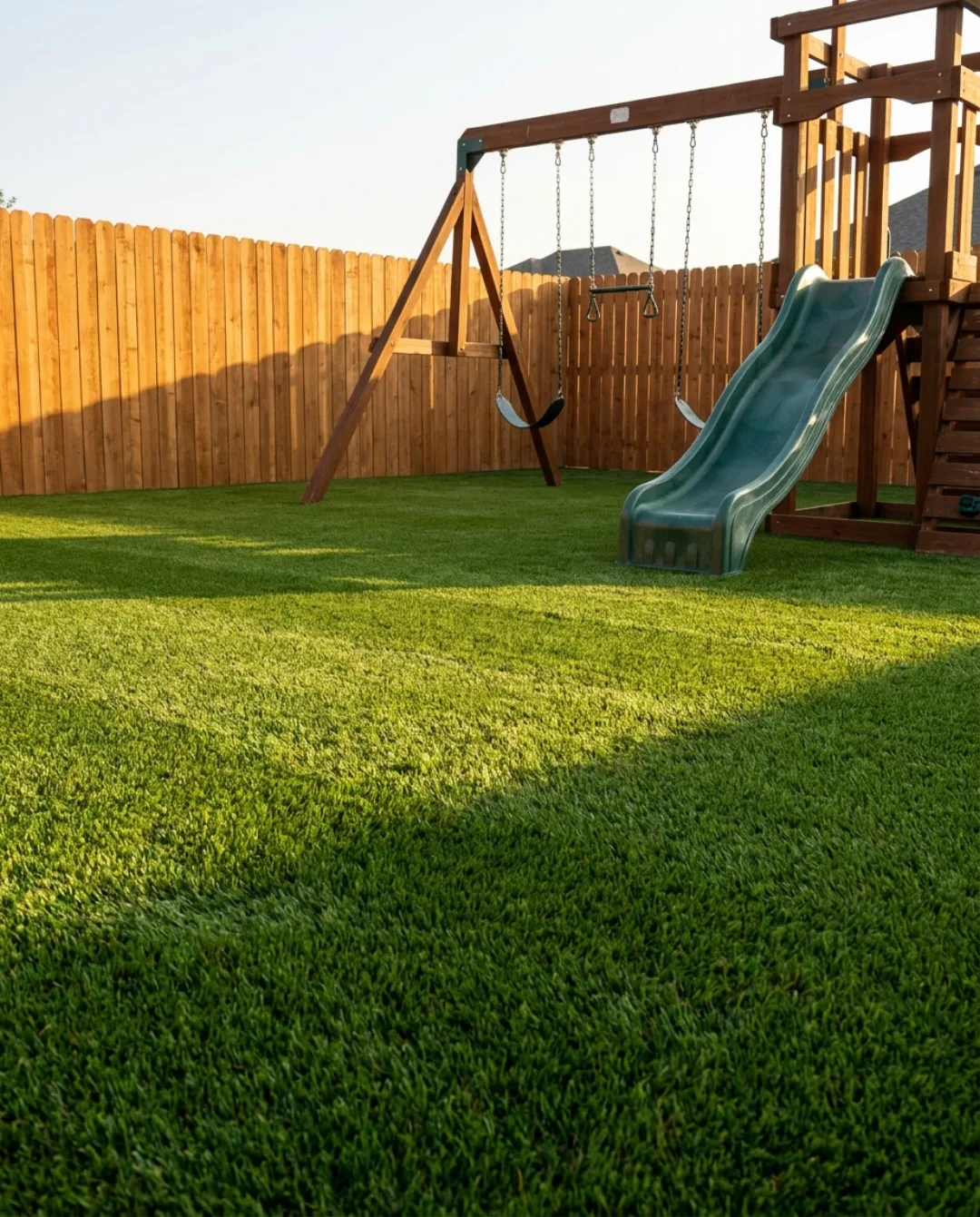
Lubbock Artificial Turf covers Hale Center, TX with the same offer it makes anywhere else on the map: a free quote, priced by the measured square foot, with no obligation. The town sits at the intersection of Interstate 27 and Farm to Market Road 1914 in central Hale County, about 33 miles north of Lubbock and 11 miles southwest of the county seat at Plainview. It took its name from its position, formed in 1893 when two rival communities founded two years earlier, Hale City and Epworth, merged into one town; the Santa Fe Railroad arrived in 1909. The 2020 census counted 2,062 people.
Hale Center covers 1.44 square miles on the Llano Estacado in a semiarid climate, which is a polite way of saying lawns here live entirely on what homeowners pour into them. Hale County averages 19.34 inches of rain a year across a 211-day growing season, and the ground under the town is flat, with fertile sandy and loamy soils and a great many playas. There are 877 housing units in town and an unusually high share of them are owned rather than rented, 571 of 679 occupied units, about 84 percent. That is a town full of people who plan to keep living with the yard they are looking at, which is exactly who a one-time build suits.
The front yard is the part of the lot that gets looked at every day and watered least, because the hose usually ends up out back where the family actually sits. Turfing the front settles that: it holds color through a dry August, cuts clean to walks, drives and bed edges, and never develops the ragged brown transition a sod line always gets by the second week of July.
Not every square foot has to be green. Plenty of lots here work better with turf where the family actually uses the yard and rock, decomposed granite or native beds everywhere else, which lowers the installed cost and takes the irrigation demand to zero across the entire lot rather than just the lawn. On a 1.44-square-mile town grid, that mix usually reads better than wall-to-wall anything.
Complete yard rebuilds from the ground up: old sod and topsoil out, three to four inches of compacted crushed base in, landscape-grade synthetic grass fastened and infilled on top, graded so what rain the high plains sends drains through instead of pooling against the slab. Hale Center sits on the corridor between Lubbock and Plainview, an easy run from either end of the county.
Patios, Strips and Small Areas
Courtyard patches, walk strips, and the odd corners where grass gave up years ago. Small-area installs use the same base and fastening spec as a full lawn, sized and priced against the actual square footage. They carry a higher per-foot rate, since crew and equipment cost the same regardless of footage, but a strip that never grew grass anyway is often the most satisfying ground on the lot to finish.
Hale Center has unusually clear water documentation for a town its size, and it is worth reading before deciding what to do with a lawn. The city's municipal water system, TX0950002, is a groundwater system, and the city's own Annual Drinking Water Quality Report says so without hedging: the City of Hale Center provides ground water from the Ogallala Aquifer located in Hale County.
The report lists each of those wells individually, and every one of them draws Ogallala groundwater. Nine municipal wells for a town of 2,062 people is a lot of infrastructure pointed at a single aquifer, and every lawn in Hale Center is watered out of it. That is the whole case for a surface that does not ask for any of it.
Hale County sits entirely inside High Plains Underground Water Conservation District No. 1, where non-exempt wells face an allowable production rate of 1.50 acre-feet per contiguous acre per year, eighteen inches, and any well expected to produce 17.5 gallons per minute or more has to be permitted before it is drilled. Hale County had 468,000 acres under irrigation as of 1982. None of that is a crisis headline, and it is not dressed up as one here. It is simply the context: a finite, actively managed supply pulled from nine holes in the ground, and a synthetic lawn is one household's way of taking its landscape entirely out of the draw. Hale Center posts no city watering schedule or drought stage, so this page will not quote one; ask the city directly.
Where Artificial Turf Beats Irrigation on the High Plains
A natural lawn in a semiarid climate is an irrigation project with grass on top. Up here the sun is strong, the air is dry, and evaporation takes its cut of every gallon before the roots ever see it. Whatever a Hale Center household spends keeping a lawn green, it spends again every single year, and a hot summer raises the bill at precisely the moment the lawn looks worst.
Synthetic turf changes that equation to zero. No irrigation, ever, not in July, not in a drought year, not when watering gets restricted somewhere down the line. The only water a turf yard takes is an occasional rinse if there are pets. The install cost is real and it is paid once, while the watering cost of natural grass never retires. On the dry side of Texas that is the whole argument in two sentences.
Wind is a permanent design input here, not an occasional one. A good share of the town's housing dates to the decades after the mid-1960s: the 1960s and 1970s cohorts together account for 333 of the 877 units, which means established lots, mature trees and irrigation systems old enough to have been repaired more than once. Turf does not make weather claims, and no yard surface should. What a fastened perimeter, bonded seams and a full infill load do is separate a surface that stays put from one that peels at the first loose edge.
What to Ask a Turf Installer Before You Sign in Hale Center
Most turf failures were lost underground, so judge an installer on the parts of the job you will never see again. Ask what goes under the grass and expect an answer in inches of compacted crushed rock laid in lifts, not turf stapled over scraped dirt. Ask how the edge is held down and expect galvanized spikes at a named spacing into a secured perimeter, because a glued or floating edge works itself free on open ground. Ask the infill rate per square foot, since infill is the ballast that keeps fibers upright and the surface planted.
Then ask how the number is built. A complete quote prices from measured square footage and names the base, the turf backing and face weight, the infill, the fastening and any demolition and haul-off as separate lines. A price with no scope behind it cannot be compared to another price, which is usually why it was written that way.
One question is local. With a median build year of 1966 and 84 percent ownership, most Hale Center jobs are established lawns on long-held lots, which means demolition and haul-off, capping old sprinkler lines, and working around mature trees whose roots set the excavation line. Ask how each of those is priced. An installer who has quoted an older Hale County lot will answer immediately; one working from a template will start talking about turf samples instead. Quotes are free and there is no obligation.
The starting point is national data. Cost guides HomeGuide and Angi track installed artificial turf at about $5 to $20 per square foot, with most home lawns landing between $8 and $14, which prices a typical 500-square-foot yard at roughly $4,000 to $7,000. Pet-grade builds run higher, about $10 to $18, for the upgraded backing and infill. Repairs price by the scope of the fix instead, so a lifted seam and a failed base never carry the same number, and either way the scope has to be pinned down before the price means anything at all.
A Hale Center yard finds its place in those ranges through the usual levers: how much old lawn has to come out, how equipment reaches the back, what the drainage grade needs correcting, and the turf spec itself. With a median home value of $76,200 and 877 units in town, the per-square-foot breakdown is worth reading closely, because smaller areas always carry a higher per-square-foot rate. The labor and the compactor cost the same at 200 feet as at 2,000. One local note worth acting on: at 33 miles out, pairing jobs, the front yard with the dog run, a repair with an install, spreads a single trip across more footage and improves the per-foot math. Quotes are free with no obligation.
Wondering what your yard would cost?
Call for a free quote. If the price doesn't work, that's the end of it — no follow-up calls.
No. Hale Center is about 33 miles up I-27 from Lubbock, on the corridor between the city and Plainview, and it is inside the working service area. Quotes are free and there is no obligation.
How much water does artificial turf actually save?
All of the landscape irrigation. Turf needs none at all; the only water involved is an optional rinse for pet areas. Whatever your lawn currently drinks in a Hale County summer is the amount that goes to zero. That matters more here than in most places, because the city's own drinking water report states that Hale Center's supply is Ogallala groundwater drawn from nine named wells inside the town, under a district that caps non-exempt production at 1.50 acre-feet per contiguous acre per year.
Can you fix turf in Hale Center that another company installed?
Usually, yes. Most repairs, re-stretched seams, refastened edges, base releveling, fresh infill, do not depend on who did the original work. An inspection of the base, the seams and the edges is what separates a repair from a replacement, and the reasoning should come attached to whichever recommendation you get rather than as a verdict.
Does turf work on the small strips and courtyards common in town?
Yes, and small areas are worth quoting here. They carry a higher per-square-foot rate than a full lawn, since crew and equipment costs do not shrink with the footage, but a strip that never grew grass anyway is often the most satisfying square footage on the lot to finish, and it phases cleanly into a full-yard project later.
Get a Free Turf Quote in Hale Center
Tell us whether it is a new install, a drought-proof layout or a repair, and you get a call back with a real number. Quotes are free and there is no obligation.