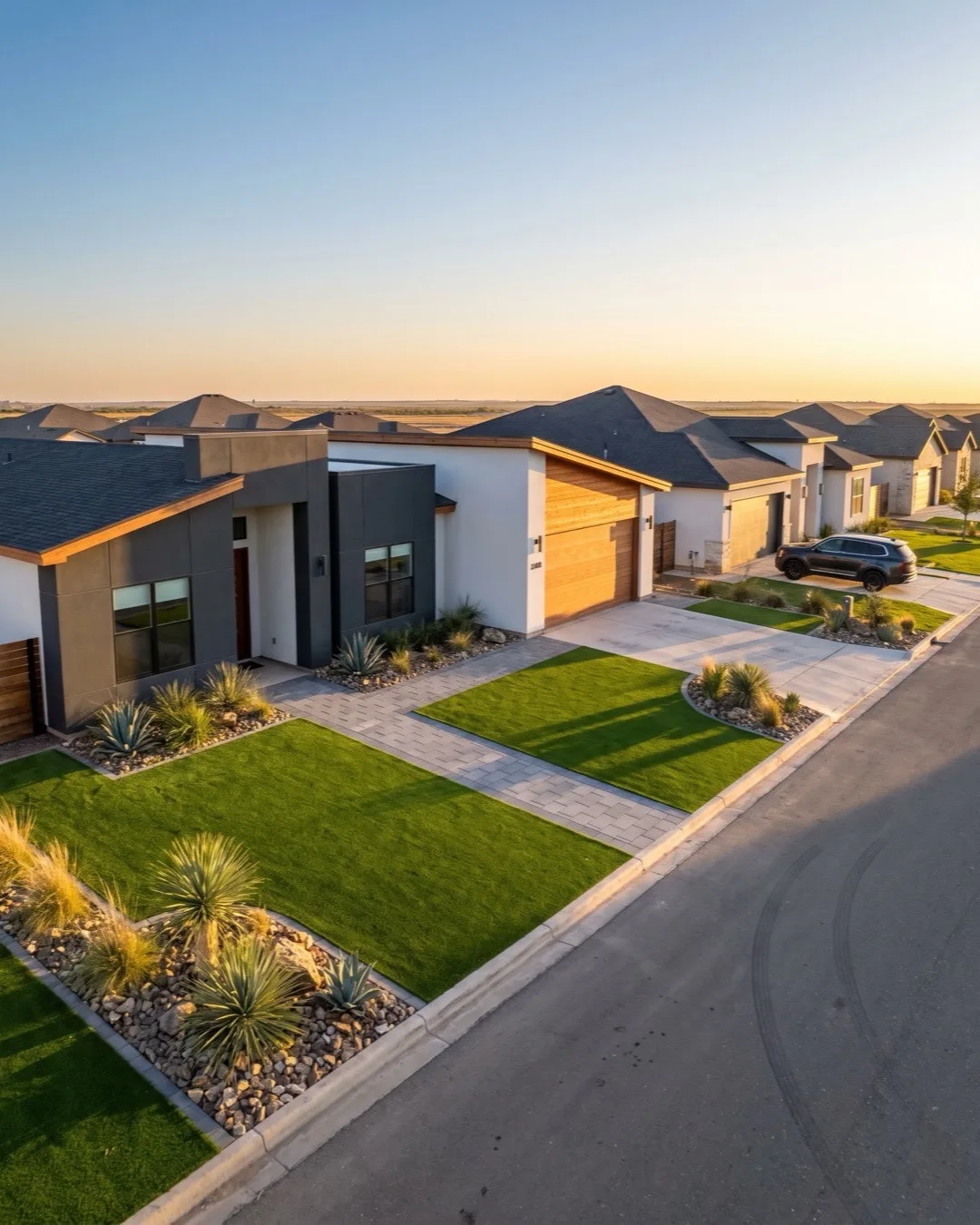
Lubbock Artificial Turf installs front yard artificial grass: the street-facing lawn, the parkway strip, the bed edges, and every cut against the walk and the drive. A front yard is a different job from a back yard for one reason. It is on display. Every seam, every edge, and every transition gets looked at daily, by you and by everyone driving past. Quotes are free and there is no obligation.
A front lawn here is asked to look good under rules that make looking good hard. Outdoor watering is limited to two days a week by house number, never on Sundays, from April through September, and midday watering is prohibited. Tiered water rates charge more the harder you push irrigation, and there is no city turf rebate in Lubbock to offset any of it. On top of that, bermuda goes dormant after the first freeze, which arrives around November 11, and does not green up again until late March or April, so a natural front lawn is tan for roughly five months a year. The weed ordinance is the other half of it: growth over 8 inches carries a $200 administrative fee.
Artificial grass answers all of that, but only when the finish work is right. In a back yard, a slightly rough cut at a bed line is between you and the dog. In a front yard it is the first thing a neighbor's eye lands on. So a front-yard build spends its extra hours on edges: the mow-strip transition, the cut against the concrete, the line where turf meets gravel or mulch, and where the seams fall relative to the street.
What a Front Yard Artificial Grass Install Includes
Cut to the concrete, not near it
The walk, the driveway, and the curb strip get a cut trimmed tight to the concrete with the perimeter fastened underneath, so there is no gap collecting grit and no lip to catch a shoe. Up close, this is the detail that decides whether a front yard reads as landscaping or as a product.
Seams planned around the street view
Rolls get planned against the sightlines that matter: the approach up the sidewalk, the view from the driveway, and the angle from the front door. Grain runs one direction across the whole lawn so the color reads even, and seams land where the eye is not already going.
Bed lines, tree rings, and mow-strip transitions
Planting beds get a clean radius instead of a chopped one, tree rings are cut with room left at the trunk, and where turf meets a mow strip or a paver band it finishes flush rather than proud. Curves are where a rushed install gives itself away first.
A fiber that reads as a kept lawn
Street-facing turf gets a landscape-grade fiber around a 1.25 to 2 inch pile with a brown thatch layer and blended green tones, picked from physical samples held in your own yard in daylight. Where an HOA has appearance rules, pile height, color, and edge treatment are all specs that can be set to match them.
Front yards break into four patterns. The base build underneath is identical in all of them; the layout and the edge work are what change.
Full Front Lawn Conversions
Curb to foundation, everything that used to be grass becomes turf, with the beds and the walk cut in clean. The simplest layout to look at and the most demanding to edge, because nothing else in the yard is competing for attention.
Turf Panels With Xeriscape Beds and Rock
A green panel where you want the lawn look, and gravel, agave, and boulder beds where you do not. Less turf square footage, more linear edge detail, and it keeps the front from reading as one flat sheet of green.
Parkway and Curb Strips
The band between the sidewalk and the street takes the worst of the sun, the car doors, and the foot traffic, and it is the first thing to give up under a two-day watering week. It is also small enough to do on its own before committing the whole front.
Entry Walks, Porch Panels, and Tree Rings
Small turf panels flanking a walk, tucked under a porch, or ringing a front tree where grass never filled in anyway. Low square footage, high visibility, and every cut has to be exact.
The five steps are the same as any turf install. In a front yard, the first and the fourth carry the extra hours.
1
Measure, map sightlines, pick samples
The lawn area gets measured, the beds and hardscape edges get mapped, and color and pile get chosen from samples laid in the actual front yard in daylight. The street and sidewalk sightlines get noted here, because they drive the seam plan.
2
Sod out, heads capped, edges defined
Old sod, roots, and three to four inches of soil come out, sprinkler heads inside the turf footprint get capped and live lines marked, and the bed and hardscape edges get cut to their finished shape before any base goes in.
3
Base in, compacted, graded away from the house
Crushed base goes in wetted and compacted in lifts, graded to fall away from the foundation and out toward the walk or the street, and set to a depth that leaves the finished turf level with the concrete rather than standing above it.
4
Rolls laid to the seam plan, then edged
Turf relaxes in the sun, gets cut to the perimeter and the bed lines, seams close on tape and adhesive exactly where the plan put them, and the perimeter fastens to a nailer board or bender board at close spacing.
5
Infill, broom, and a look from the sidewalk
Silica infill is power-broomed in, the lawn is blown clean, and then the finished yard gets walked from the sidewalk and the driveway. That is where any edge that is not right will announce itself.
How Much Does Front Yard Artificial Grass Cost in Lubbock?
A front lawn is priced the same way as any other turf job, from measured square footage. Published national cost guides put installed artificial turf at roughly $5 to $20 per square foot, with most residential lawns at $8 to $14, which puts a 500-square-foot front yard at about $4,000 to $7,000.
Front yards do carry two quirks worth knowing. They are usually smaller than back yards, and the rate per foot runs higher on smaller areas because setup and crew time barely move with size. They also have more linear edge per square foot, since walks, drives, beds, and tree rings are all cut and fastened by hand. Those are published national ranges, not a quote, and yours comes from measuring the actual lawn.
Will the neighbors be able to tell it is artificial?
Standing on it, most people can. From the street, the usual tell is that the lawn looks healthy in January when nothing else on the block does. Blended color tones, a brown thatch layer, and blade shapes that scatter light instead of shining are what keep it convincing. Pick the fiber from samples outdoors rather than from a screen.
Will my HOA allow artificial grass in the front yard?
That is a question for your HOA's own covenants, and they differ from one neighborhood to the next, so read them or ask the board before anything is ordered. What an installer can do is build to whatever the rules say. Pile height, color, and how the turf meets the walk and the beds are all specs that can be set to a requirement.
How is a front yard install different from a back yard?
Visibility drives every difference. Seams are planned around the view from the street rather than from the patio door, the edges against concrete and beds take more hours because they get seen up close, and the layout has to account for the walk, the drive, and the parkway strip. The base build underneath is the same.
Can I keep my trees and flower beds?
Yes. Beds get cut to a finished shape and edged, and trees get a ring left open at the trunk so the root flare can breathe and water can still reach it. Irrigation zones feeding trees and beds keep running; only the heads inside the turf area get capped.
Does a west-facing front lawn get too hot?
Turf in direct sun runs warmer than natural grass, the same way a driveway or a deck does, and Lubbock has 92 days a year at 90°F or above for it to prove that. A rinse brings the surface down quickly, lighter fiber colors run cooler, and a front lawn is generally looked at more than it is sat on.