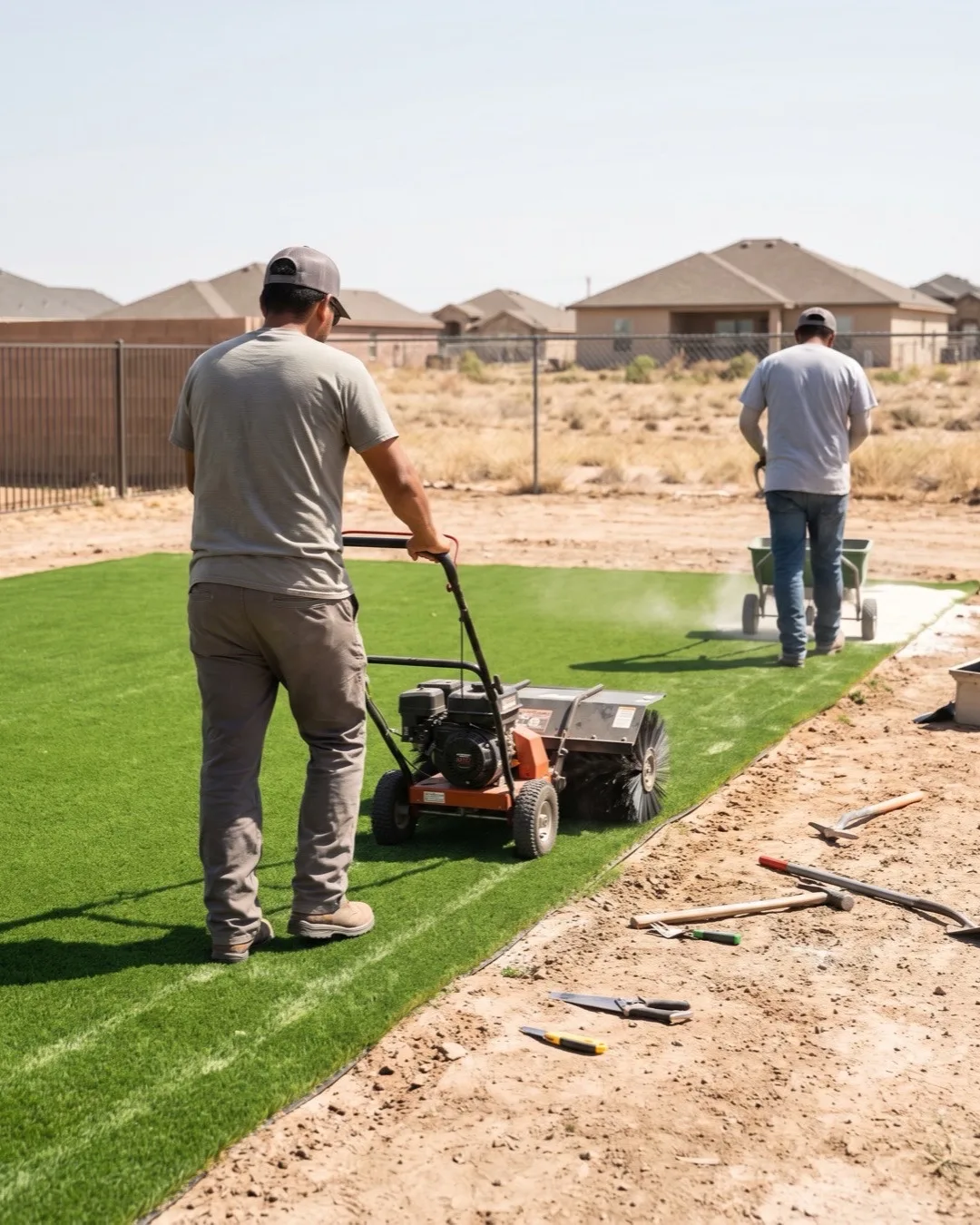
A town named for fresh, clear water still has to spend it carefully. At 20.68 inches of precipitation a year, every green natural lawn in Tahoka is a standing irrigation commitment, twelve months of pumping water into ground that gives it straight back to the sky. Synthetic grass deletes that line item. The only water a finished turf yard ever asks for is an occasional rinse of the pet area, and rainfall, when it comes, passes through the perforated backing into the compacted base and drains away instead of ponding.
The summers argue the same direction. At the recorded extreme of 116 degrees, keeping real grass alive is a fight you refinance every week at the meter. Turf does not wilt, does not brown out in August, and does not care whether the next rain is tomorrow or in October. The winter side is just as easy: at 15 below zero there is nothing in a turf system to freeze out, because there is nothing alive in it.
Tahoka's own institutions tell you where local water goes. This is farming and agribusiness country whose largest employers are the Lynn County Hospital District, the school district and Lyntegar Electric, and the fields around town have the first claim on every gallon. Lynn County sits fully inside High Plains Underground Water Conservation District No. 1, where the Ogallala is the major aquifer, an unconfined water-table formation whose depth to water runs from a few feet below the surface to over 450 feet. A residential lawn is the one irrigated acre in the county that produces nothing. Turf retires that acre without losing the green.
There is a native answer to the same problem growing right here, which is worth noticing. The Tahoka Daisy, a prairie aster with two-inch lavender-blue flowers, a golden-yellow center and fern-like foliage, was first noted at Tahoka Lake Ranch around 1898 and now appears on the city's own website. It thrives on exactly the rainfall this county gets. Imported turfgrass does not, and that gap is the whole reason a synthetic lawn makes sense at this latitude.