Lubbock Artificial Turf wrote this page to be useful rather than to sell anything. Infill is the least visible decision on a turf project and one of the most consequential: it is the difference between a lawn that still stands up in year six and one that lies down flat in year two. Seams and perimeter edging are the other two details that separate a good install from a cheap one. All three are covered here in plain terms, with the trade-offs stated.
Lubbock makes each of these details matter more than it would elsewhere. This is the tenth-windiest city in the United States, averaging 12.4 miles per hour, so infill weight and perimeter fastening are what keep a surface flat and an edge down. Blowing dirt is a documented local reality, and airborne dust settles into any turf surface over time. The heat is real too, with 92 days a year at 90°F or hotter and 13.3 days at 100°F or hotter. And with 18.33 inches of rain in an average year, most of it arriving in bursts, infill has to let water through rather than hold it.
None of what follows requires hiring us. If you are comparing bids, the useful move is to ask each installer to name the infill type, the rate it goes down at, how the seams are closed, and how the perimeter is fastened. A bid that answers those four questions in writing can be compared to another one. A bid that just says turf, installed cannot.
Turf is a fabric, and a fabric expands, contracts, and lifts. Infill is the weight that keeps it lying flat against the base and keeps wind from getting under it. On a windy site an underfilled lawn will ripple and pull at the perimeter, which loads the edge fastening with work it was never meant to do alone.
Blade support: it is why turf stands up
Infill sits between the fibers and props them upright from the bottom. Without enough of it, blades fold over and stay folded, and once a fiber has taken a permanent set no amount of brooming brings it fully back. Matting in a walking path is almost always an infill-level problem before it is a turf-quality problem.
Drainage: it has to pass water, not hold it
Water goes through the turf backing, through the infill, and into the compacted base below. Infill that packs tight or breaks down into fines slows that path and can leave a surface holding moisture after a storm. Clean, properly graded and rounded material keeps the column open.
Temperature and feel: honest limits
Infill changes how a surface feels underfoot and how firm it sits. Some materials, notably zeolite and certain organics, hold a little moisture and give up a small amount of cooling as it evaporates. Do not expect that to make turf cool in direct August sun. No infill turns a synthetic surface into shade; a rinse and a shade sail do far more.
Five materials cover almost every residential job. None of them is best at everything, which is why the choice depends on what the surface is for.
Silica Sand
Rounded, kiln-dried silica sand is the default for landscape lawns. It is the cheapest option, widely available, and does the ballast and blade-support job well. Its weakness is pets: plain sand traps urine and holds odor, and a dog yard filled with it goes sour. It can also pack down over years in high-traffic paths, which is what a power broom and a top-off fix.
Coated and Antimicrobial Sands
Silica sand with an acrylic or antimicrobial coating. The coating helps the grains resist compaction, keeps them flowing, and inhibits the bacteria that produce odor, which makes it a common pet-area choice. It costs more per bag than raw sand, and the coating is a treatment, not a permanent property, so it works alongside rinsing rather than replacing it.
Zeolite
A porous volcanic mineral that captures ammonia from urine at the molecular level and releases it when rinsed, which is why it is the standard for dog runs. It is lighter than sand, so it contributes less ballast pound for pound and is often blended with sand rather than used alone. It costs more than silica, and it needs periodic rinsing to stay effective.
Rubber Crumb and Organic Blends
Crumb rubber adds real cushioning and is common on athletic surfaces, but it holds heat noticeably and it migrates, so most residential lawns skip it. Organic blends such as cork, walnut shell, and coconut fiber are the low-heat alternative, hold moisture for evaporative cooling, and are chosen by homeowners who want to avoid rubber. The honest downside is that organics are a natural material: they break down, blow around in wind, and need topping up more often than sand.
Three details, five steps. This is the sequence a proper install runs, and the sequence a bid should describe.
1
Pick the infill and the rate before the turf is ordered
The infill choice follows the use: sand for a lawn, coated sand or zeolite for pets, a heavier sand load for a putting surface, none or very little for an indoor non-infill lane. The rate is normally stated in pounds per square foot and it varies with pile height, density, and use, so the number belongs in the written spec rather than in someone's head on install day.
2
Close the seams on tape and adhesive
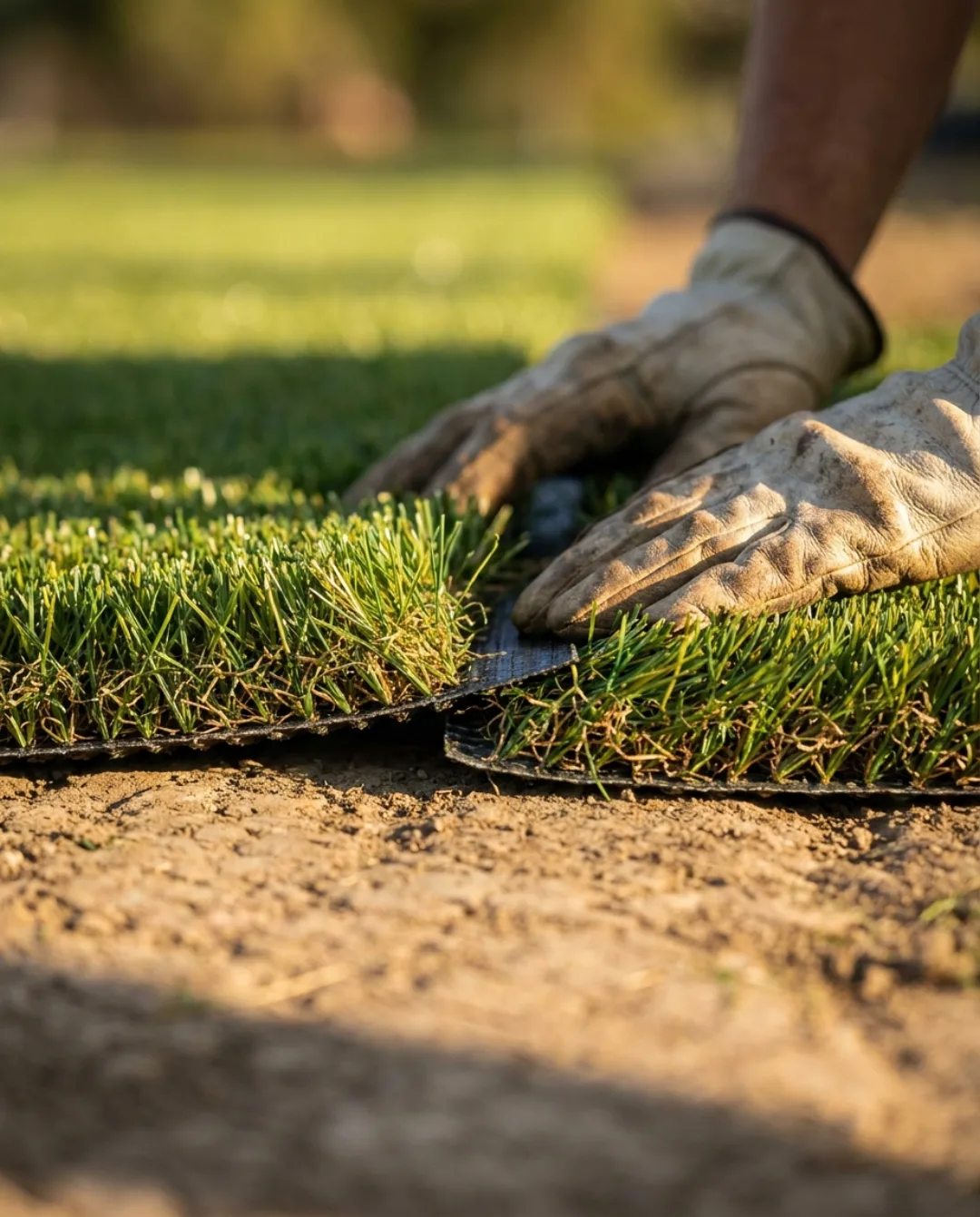
Seams are the most common visible failure on a turf yard. Rolls go down with the grain running one direction across the whole surface, because opposing grain makes a seam glow in the light no matter how tight it is. The edges are trimmed to the stitch row, joined over seam tape with adhesive, weighted while it cures, and the fibers along the join are teased free so the line disappears. Seams glued to nothing, stapled down, or set on failing tape are the ones that open into a gap a year later.
3
Fasten the perimeter, and pick the method for the edge
Four common methods, each with a place. A nailer board is treated lumber staked into the base at the perimeter, and turf fastens into it with galvanized nails or spikes; it is the workhorse for open edges. Bender board is flexible composite or plastic edging for curves. Direct spiking into a compacted base works on straight runs and is the least secure of the four. Against concrete, a paver band, or a poured concrete edge, the turf is adhered to the hard surface for a flush finish with nothing to lift. In a windy yard, fastener spacing gets tightened, especially at corners.
4
Drop the infill in passes and broom it in
Infill goes down in several light passes with a drop spreader, never one heavy dump, then gets worked down to the backing with a power broom. Brooming is what stands the fibers up and pulls the grains to the bottom of the pile where they belong. Infill sitting on top of the blades means the job is half done.
5
Check it, and top it off when it settles
Infill settles, migrates out of traffic paths, and in pet areas gets rinsed thinner over time. The test is simple: part the fibers with your hand and look at where the infill line sits against the blade. If the blades are supported well up their length, it is fine. If the infill line has dropped and the fibers are folding, it is time for a top-off and a power broom, which is far cheaper than replacing matted turf.
Where Infill, Seams, and Edging Sit in a Turf Price
Infill is bought by the pound and is a line inside the installed price rather than a separate purchase for most homeowners. Published national guides put installed artificial turf at roughly $5 to $20 per square foot, with most residential lawns at $8 to $14 and pet systems higher at about $10 to $18, and part of that pet premium is exactly this: coated sand or zeolite instead of plain silica, plus a flow-through backing. We are not going to publish a per-bag price we cannot source.
Those are published national ranges, not a quote. What matters when comparing bids is that the infill type and rate, the seam method, and the edge detail are named in writing. These are the three places a low bid usually finds its savings, and all three are invisible from the surface on the day the crew drives away.
On most outdoor lawns, no. Without infill the turf has no ballast and the blades have nothing holding them upright, so the surface mats early and the perimeter takes wind loading it was not designed for. The exception is genuine non-infill turf, a denser, stiffer product engineered to stand on its own, which is common on indoor gym lanes. It is a different product at a higher price per roll, not the same turf with the sand left out.
How much infill does a lawn actually take?
It depends on pile height, fiber density, and use, which is why the rate belongs in the bid as pounds per square foot rather than as a guess off a web page. Taller pile takes more, putting surfaces take a heavier load to set speed, and pet areas are filled to a rate that keeps the specialty material working. Ask the installer to name their number and to say what happens if the surface needs more later.
How do I tell when infill needs topping up?
Part the fibers with your fingers and look at where the granules sit relative to the blade. Infill well down the blade with the fibers standing is healthy. A dropped infill line, blades folding in the traffic path, or footprints that stay visible are the signs. Power brooming with a top-off usually restores it, and it is one of the cheapest things you can do to an aging lawn.
Why do some seams show and others do not?
Three usual causes. Grain running in opposing directions on either side of the join, which makes the two panels reflect light differently. Fibers pinched into the adhesive along the seam and never teased free. Or a starved or failing bond that lets the edges drift apart. A seam done properly, with the grain one direction and the join fed enough adhesive, is genuinely hard to find once the infill is in.
Which perimeter edging holds up best?
For open edges against soil or beds, a staked nailer board takes fasteners better than anything else and is what we default to. Curves call for bender board. Straight-run spiking into base is the cheapest and the first to lift. Against concrete or a paver band, adhering the turf to the hard edge gives the cleanest, flattest finish. On a windy site the spacing between fasteners matters as much as the method, especially at corners, where lifting always starts.