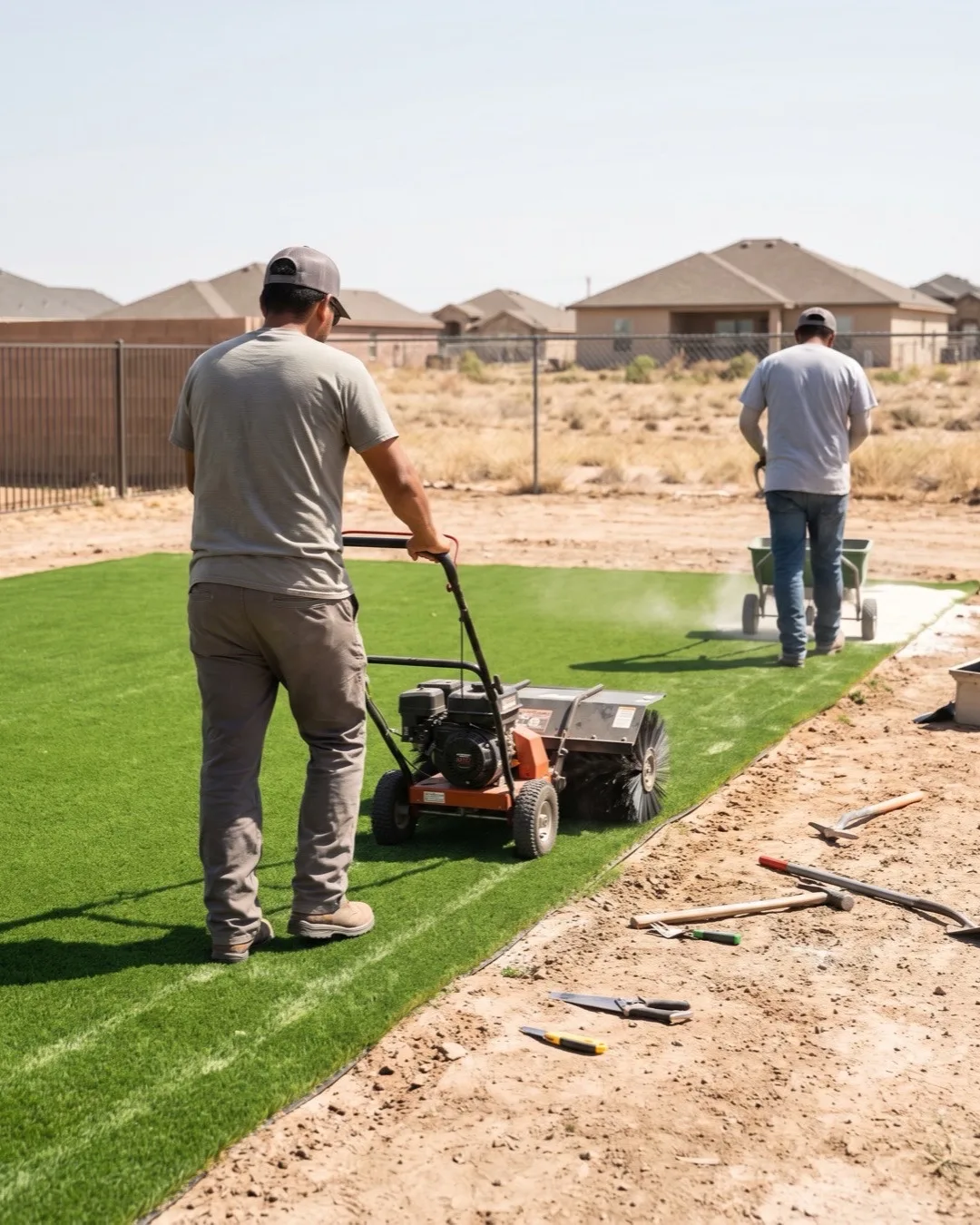
Lubbock Artificial Turf installs artificial grass in Sundown, TX, and the pitch here is straightforward. This is a town of 1,283 people at the 2020 census, down from 1,397 in 2010, sitting at 3,540 feet in Hockley County on roughly a square mile and a half of entirely rural ground where FM 301, known in town as Richardson Street, meets FM 303. A yard in a place like this should not need babysitting. The work is priced by the square foot, quotes are free, and there is no obligation.
Sundown earned the nickname Boomtown, USA after the 1937 oil strike, incorporated in 1947, and grew up on land surveyed out of the C. C. Slaughter ranch in 1926. The economy still runs on it: oilfield services dominate, with some cotton and some ranching around the edges. Sundown ISD teaches the town from three campuses on South School Street, an elementary for PK-5, a junior high for 6-8 and the high school, whose marching band holds UIL state records for most total appearances at 28, most finals appearances at 26, and a tie for the most championships at 8. Yards here are family yards, and that daily kid-and-dog traffic is exactly what synthetic turf handles better than live grass, which wears thin in the goal-mouth spots and never quite recovers.
Full conversions on a compacted crushed base with positive drainage, turf stretched drum-tight and fastened at the perimeter, infill worked in until the blades stand up. Face weight and pile height get matched to how the yard actually gets used, because a display front lawn and a kid-trampled back yard are not the same spec and should not carry the same price.
Play Areas and Backyard Playgrounds
For swing sets and play structures we install a taller, softer fiber over a foam shock pad, so falls land on cushion instead of packed dirt. Pad thickness gets chosen for the fall height of the equipment above it. It is the same surface logic schools and parks use, scaled down to a back yard.
Pet Areas and Dog Runs
Perforated backing, a base graded flat with no pooling, and an infill chosen to control odor. A dog area that hoses clean beats a mud patch every month of the year, and droppings pick up as easily as they would off short grass while the rest rinses through to the base below.
Not every yard needs to be a dog yard. A defined potty zone, sized to the dog and placed where you want it rather than where the dog picked, keeps the odor management, the heavier drainage and the specialty infill confined to a small area while the rest of the lawn stays standard spec. It is the cheapest way to buy the pet-grade build without paying pet-grade rates across the whole property.
Six Wells Serve Sundown, and a Lawn Does Not Have to Draw on Them
The City of Sundown runs its own water system out of 809 Slaughter Avenue, and it does it on 6 water wells and 2 booster stations. That is the whole supply for the town. Six wells is a specific, finite number, and it is worth holding in mind the next time a sprinkler system runs through a July afternoon on an open lot at 3,540 feet, where evaporation is working against you the entire time.
Nothing about a turf yard draws on that system. Rain moves through the perforated backing into three to four inches of compacted crushed base and out along the grade set at installation, and the only hose work a finished yard ever needs is an optional rinse of a pet corner. Whatever a Sundown lawn would have drunk over a summer is the amount a turf yard gives back, in the driest years as much as the wet ones.
That matters more in a small system than a large one. A town supplied by a handful of wells has less slack than a city, and residential lawn irrigation is the largest discretionary draw on most household meters anywhere. Taking it to zero on one property is a small thing; taking it to zero permanently, without depending on anyone's willpower in August, is the part worth paying for.
Sundown sits at 3,540 feet, one of the higher townsites on the South Plains map, and elevation sharpens both the sun and the dry air. That combination is punishing on sod and irrelevant to a properly specced synthetic lawn. UV-stabilized fiber is rated for exactly this exposure, and a spiked, board-fastened perimeter carrying a full infill drop keeps the surface planted no matter what the wind does across open country.
The town's own history is a run of things built to take a beating. The oil strike of 1937 turned a set of surveyed farm tracts into a town, a cotton gin went up in 1932, a 1949 tornado tore through the town and Sundown kept going, and today a museum in town holds the oilfield history and the paintings from the boom years. Sundown is also famous as the small town with the long main street, two and a half miles of it. This is not a place that expects things to be delicate.
A yard conversion applies that same standard at house scale. Ground that costs money to keep alive gets rebuilt as ground that simply works: crushed rock compacted in lifts, a perforated backing that drains, fiber rated for the sun it will actually get, and edges that treat the wind as a permanent neighbor rather than an occasional guest. The yard the kids leave in August is the yard they come back to at Christmas.
Most bad turf jobs fail underground, so judge an installer by the parts you will never see again. Ask how deep the base goes and what it is made of, and expect crushed stone compacted in lifts rather than turf rolled over graded dirt. Ask how the yard drains, since a proper install sheds water through the turf's perforated backing and out through the base along a planned grade, and a bidder who cannot trace that path is guessing.
Then ask about the visible half. What face weight and pile height is being quoted, what infill goes down and how many pounds per square foot, how the edges are secured, and what the warranty actually covers. In an oilfield town where equipment access matters, ask how the crew gets base material to the back of the lot, because on a fenced yard with a narrow side gate that logistics question is a real line item rather than a detail.
Finally, ask whether the price is broken out by the square foot, because a per-foot number is what lets you set one bid beside another line by line. Ask for demolition and haul-off to be itemized separately from the build, and for sprinkler capping in the work area to appear in the scope. Quotes are free and there is no obligation, so asking costs nothing.
Start from the published national ranges: cost guides place installed artificial turf between $5 and $20 per square foot, most residential lawns settle in the $8 to $14 stretch, and a typical 500-square-foot yard lands around $4,000 to $7,000. Play surfaces price above plain lawn spec because the foam shock pad is an added layer, and pet areas run roughly $10 to $18 for their upgraded backing and infill. Those are ranges for judging bids, not a Sundown quote.
From there, a Sundown price moves on the same levers as anywhere on the South Plains: how much existing lawn has to be demoed and hauled, how equipment reaches the back of the lot, what the drainage grade needs, and the fiber spec the yard's traffic calls for. A compact town of fewer than 1,300 people also rewards bundling, since quoting the lawn, the play corner and the pet zone as one job spreads fixed costs across more footage and improves the per-foot number on all of it.
The one item nobody should trim in Sundown is the fastening schedule. At this elevation on open ground, spiked perimeters and a full infill load are not upgrades, they are the build, and they belong priced into the scope from the start rather than discovered later. Quotes are free and there is no obligation.
Wondering what your yard would cost?
Call for a free quote. If the price doesn't work, that's the end of it — no follow-up calls.
Does Sundown actually get served, or is it too far west?
It does. Sundown sits in Hockley County on the west side of the map, where FM 301 and FM 303 meet, and artificial turf installs there get quoted like any other job. Quotes are free and there is no obligation.
Rural water is precious out here. How much does turf actually need?
None for the surface itself. The city runs its whole system on 6 water wells and 2 booster stations, and a turf yard adds nothing to that load. Rain drains through the perforated backing and the compacted base, and the only hose work is an optional rinse of a pet corner. That zero holds in a dry year too, when a sod lawn would be the first thing in town to show it.
What should a Sundown homeowner compare between two turf bids?
Base depth and material, the drainage plan, turf face weight and pile height, infill type and load, edge fastening, and the warranty. If two bids differ a lot in price, one of those line items is usually where the money went missing. Setting two bids side by side and reading them line against line takes about ten minutes and usually settles the decision.
Is turf safe under a swing set?
Built correctly, yes. Play-area installs add a foam shock pad under a softer, taller fiber, which is a gentler landing than bare ground or worn grass, and the pad thickness gets chosen for the fall height of the equipment above it.
Get a Free Turf Installation Quote in Sundown
Send a few details about your yard and you will get a call back. Free quote, no obligation.