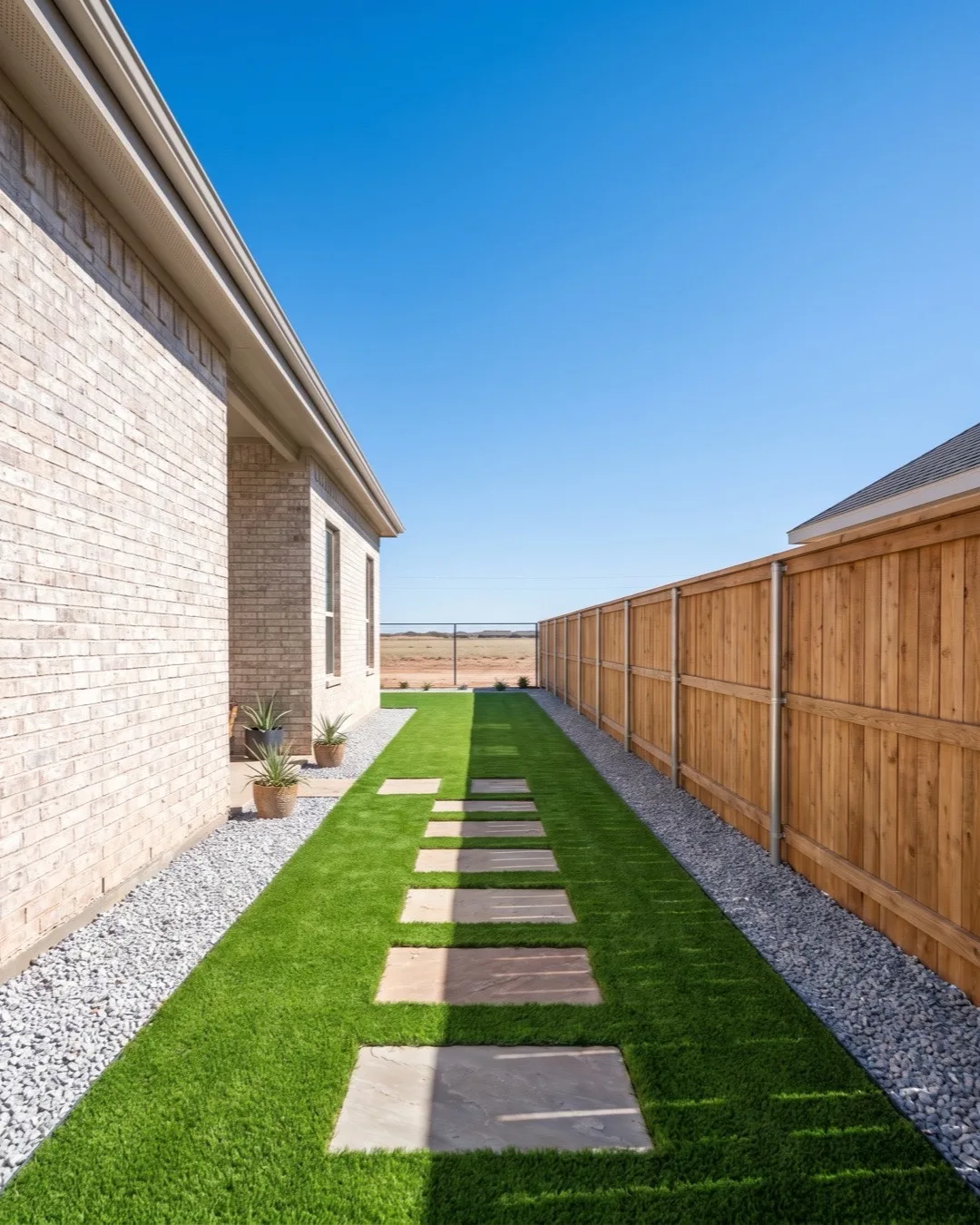
Lubbock Artificial Turf installs dog potty areas: the small dedicated patch of turf by the back door, on a patio, or on a balcony, sized for one dog's business instead of a whole yard. It is the smallest job on our list and one of the most useful, because it solves a specific daily problem rather than a landscaping one. Quotes are free and there is no obligation.
The strip of ground a dog actually uses is the first part of any Lubbock yard to give up. The city averages 18.33 inches of rain a year, holds outdoor watering to two days a week by house number with no Sundays from April through September, and prohibits midday watering, so that one patch never gets the extra help it would need to recover. Bermuda goes dormant after the first freeze, which lands around November 11, and does not green up again until late March or April, leaving it bare or tan roughly five months a year. Then there are the stickers: goatheads and sandburs, documented invasive problem plants by Texas A&M AgriLife, take over exactly that kind of thinned-out ground and end up in paws.
A potty patch takes that one square of the yard out of the fight. Turf over a base that drains, an odor-control infill, and an edge that contains it, in a footprint you can rinse off in one pass with a hose. It costs more per square foot than a full lawn install and far less in total, which is the honest way to describe a small job.
Most potty areas land somewhere around a 4-by-6 or a 6-by-8 footprint. That is enough room for a dog to circle, sniff, and commit, which matters more than raw square footage does. Large breeds and multi-dog households size up; a single small dog on a balcony can work with less. The target is a zone the dog reads as its own, not a lawn in miniature.
Placement: near the door, not against it
The patch belongs within sight of the door the dog already uses, on the route it already takes at two in the morning. A few feet of hard surface between the door and the turf gives paws somewhere to dry, so nothing wet comes back inside. Downwind of the patio and away from where people eat is worth a minute of thought before anything gets built.
Drainage, including over concrete and balconies
On dirt, the build is a full pet install scaled down: excavation, crushed base compacted in lifts and graded to fall, flow-through backing on top. On a patio, a slab, or a balcony, the turf goes over a drainage layer or a drain tray that routes liquid to an existing floor drain or off in a controlled direction. Small areas are easy to build wrong, because a flat patch with nowhere to send liquid is just a puddle with a smell.
Odor-control infill and containment edging
Pet zones get zeolite or antimicrobial coated sand, never plain silica, which holds urine rather than letting it pass. The perimeter is contained with bender board, a nailer board, a paver band, or a tray lip, so infill stays inside the patch and the edge cannot curl or lift. Per square foot, the edge of a potty area takes more abuse than any other edge in a yard.
Four situations where a small dedicated zone beats turfing the whole yard.
Apartments, patios and balconies
No yard at all, and a dog that still has to go. The build sits entirely on hard surface: a drain tray or drainage layer, turf on top, contained edges, nothing anchored into the structure. Worth checking your lease or HOA rules on what may be installed on a balcony before anything is ordered.
Small yards and back doors with nowhere to walk to
On a tight lot the whole back yard is the dog's route, which is how you end up with no back yard. Giving the dog one designated square keeps the rest of the space usable for people, and it is a small enough project to do without touching the rest of the landscaping.
Senior dogs and puppies in training
An older dog with stiff hips needs a short trip on level footing, not a walk across a yard. A puppy needs one consistent surface and one consistent smell to learn on. A dedicated patch a few steps from the door does both, and it stays the same underfoot in a drought or after a freeze.
Rainy nights, late nights, and the middle of winter
This is the version of the job people appreciate most in January. Turf over a draining base has no mud to track back in and nothing to thaw into a mess, so a two-minute trip at midnight stays a two-minute trip. Lubbock averages 7.0 inches of snow a year and the first freeze lands around November 11; the patch works the same on both sides of that date.
Five steps, scaled down from a full pet system without anything important being scaled out of it.
1
Pick the spot and the size
Where the dog already goes, how far it is from the door, and which way the wind and the slope run. The size follows the dog, not the other way around. This is also where the dirt-versus-concrete question gets settled, because it changes the whole build below the turf.
2
Prep the ground, or prep the slab
On soil, sod and a few inches of dirt come out, and crushed base goes in wetted and compacted in lifts. On concrete or a balcony deck, the surface gets cleaned and a drainage layer or tray is set instead, with the existing fall or floor drain identified first.
3
Build the fall and the drainage path
The patch is graded with no low spots and a deliberate direction for liquid to leave, aimed away from the house, the door, and the seating. On a small area this is the step that decides whether a rinse works or whether the patch just holds what you poured on it.
4
Turf laid, cut, and contained on every edge
Flow-through pet turf goes down with the grain one direction, seamed on tape and adhesive if the patch needs more than one piece, then cut to the perimeter and fastened at close spacing. Every edge gets contained so infill stays in and a bored dog finds nothing to lift.
5
Infill, rinse test, and the training handoff
Zeolite or antimicrobial infill is broomed in at full rate, then the patch gets hosed and watched as it drains. After that it is your part: leash the dog to the patch every trip for the first week, reward on the turf rather than back at the door, and leave one lightly used spot un-rinsed at first so the zone smells like the right place. Then the routine is solids picked up, a rinse a few times a week, enzyme treatment when it is hot.
What a Small Potty Area Costs
Published national guides such as Angi and HomeGuide put pet turf systems at roughly $10 to $18 per installed square foot, above lawn turf because of the flow-through backing, the denser fiber, and the specialty infill. A potty patch usually prices above even that per-foot band, and that is not a trick: mobilization, demo setup, base or tray delivery, and crew time cost about the same whether the area is a few dozen square feet or a few thousand. Those are published national ranges, not a quote.
The number that matters on a job this small is the total, and the total is the smallest of anything we install. We are not going to print one from a web page, because the slab-versus-dirt question, the drainage path, and how equipment gets to the spot move it more than the square footage does. Ask and you get a real number, free, with no obligation attached to it.
Around a 4-by-6 or 6-by-8 patch covers most single-dog households, and the shape matters as much as the size, because a dog needs room to circle before it commits. Larger breeds and multi-dog homes go bigger. A balcony patch can be smaller than either as long as the dog can turn around comfortably. If you are unsure, watch where and how your dog already goes for a few days and size to that.
Will a potty patch smell?
Not if both halves are done, and yes if either is skipped. The build half is flow-through backing, a base or tray that genuinely carries liquid away, and zeolite or antimicrobial infill instead of plain sand. The routine half is picking up solids, a hose rinse a few times a week, and an enzyme treatment every month or two in hot weather. Concentrating a dog's business into a small area concentrates the maintenance too. That is the honest trade for the convenience.
How do I train my dog to use the potty grass?
Leash, every trip, first week, same spot. Walk the dog straight to the patch, wait, and reward on the turf itself rather than back at the door. Leaving one lightly used spot un-rinsed for the first few days gives a scent cue to work from. Puppies and rescues usually take to it quickly; an older dog with years of habit takes longer. No special product is needed to make this work.
Can a potty patch go on a balcony or over concrete?
Yes, and it is one of the most common versions of this job. Over a slab or a balcony deck the turf sits on a drainage layer or a drain tray that routes liquid to an existing floor drain or off the edge in a controlled direction, instead of letting it pool under the backing. Check your lease or HOA rules on balcony installations first, and expect to lift the turf occasionally to rinse the tray underneath.
Does dog potty grass hold up through a Lubbock summer?
It holds up, with the caveat that applies to all turf: in direct sun it runs warmer than natural grass, and Lubbock logs 92 days a year at 90°F or hotter. A rinse cools it quickly, lighter fiber colors help, and a patch placed in afternoon shade barely registers the issue. Heat also speeds up odor, so the rinse schedule tightens in July and August. Most dogs find the shade on their own if you give them the option.