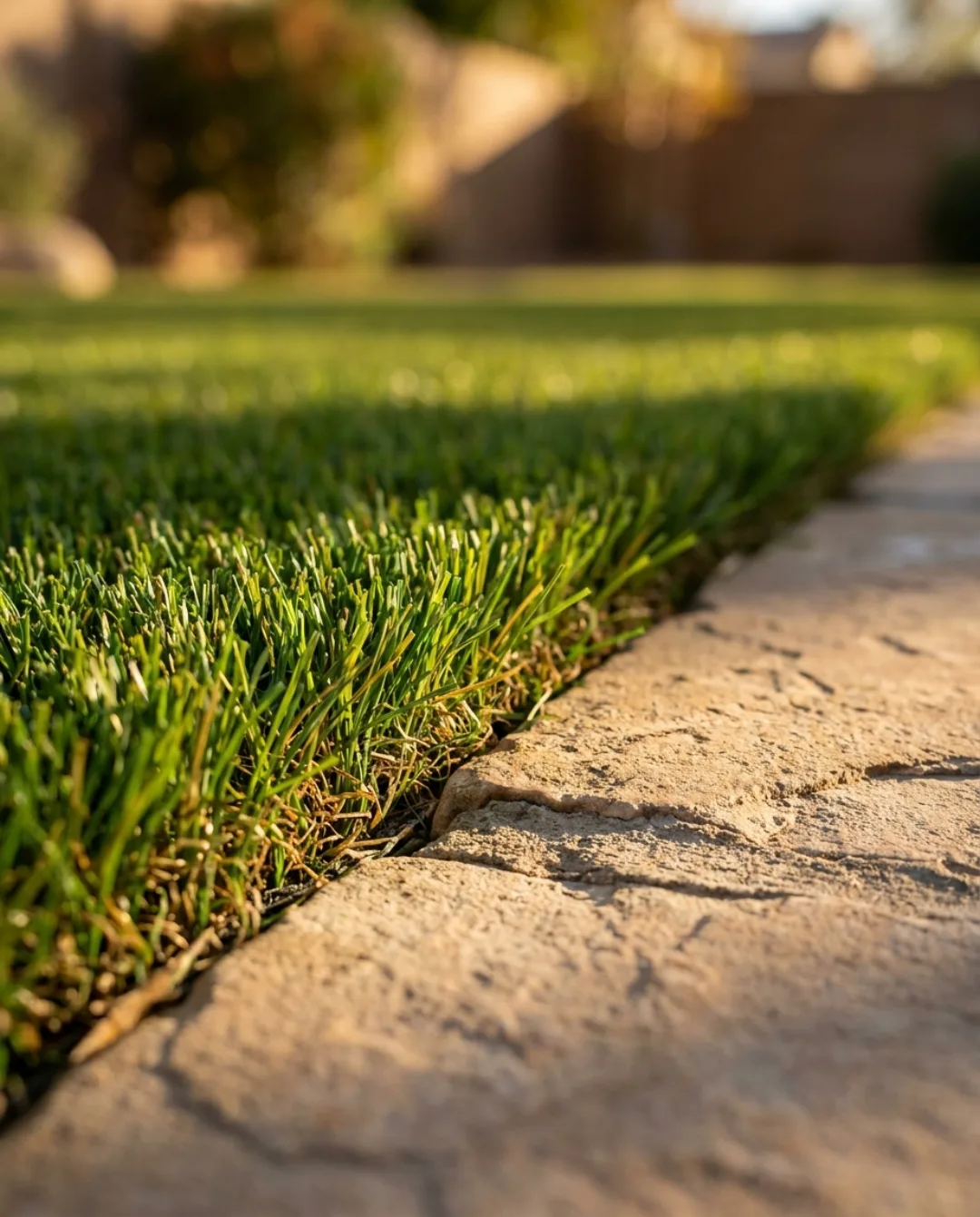
Lubbock Artificial Turf installs artificial grass in Ralls, TX on the same terms as any address closer in: measured yard, price by the square foot, free quote, no obligation. Ralls sits about 27 miles east of Lubbock in Crosby County, between Lorenzo to the west and Crosbyton to the east, at the junction of U.S. highways 62 and 82 and State Highway 207. It covers 1.35 square miles at 3,107 feet on the Llano Estacado, and the 2020 census counted 1,665 residents, down 14.4 percent from 1,944 ten years earlier. The Caprock Escarpment marks the county's southern boundary, where tributaries of the Brazos have carved the landscape into something that does not look like the flat plain people expect.
The town was founded in July 1911 by John Robinson Ralls, who moved businesses and houses over from Emma to fill it, incorporated on January 6, 1922, and grew up along the Santa Fe Railroad into a retail and shipping center with more than 100 business establishments by 1951. That is still the shape of the place: grain silos on the skyline, cotton, grains, soybeans, sunflower seed and vegetables coming off the surrounding country, Ralls ISD keeping the Jackrabbits in uniform, and the World's Largest Jackrabbit standing 14 feet 6 inches and 5,000 pounds where visitors can find it. Working yards, in other words, and grass on the High Plains is a lot of work.
Demolition of the old surface, a regrade so water leaves the house instead of pooling against it, three to four inches of crushed base compacted in lifts, then landscape-grade turf seamed, edge-fastened and ballasted with infill. Pile height is matched to how the yard is really used, and the lanes that get walked daily get a denser face weight so the lawn does not develop a bald path in year three.
Backyard Play Areas
A dedicated kids' zone with a softer fiber and padded underlayment where the fall zone needs it, over the same free-draining base as the rest of the yard. No mud tracked inside after a rain, no bare patch under the swing, and nothing that has to be reseeded every spring to look like a lawn again.
Older Ralls properties often have more usable concrete than usable dirt: a carport pad, a back patio, a walkway strip along the house. Turf goes over the slab with a drainage layer and pad underneath and edges bonded to the perimeter, which turns hot gray concrete into something soft without breaking anything up first.
Split seams, edges that have pulled loose, flattened traffic lanes and low spots that hold water are all repairable while the backing is sound, and repairs are priced by the scope of the fix rather than the size of the yard. What decides repair against replacement is the condition of the backing and the base, which has to be looked at rather than guessed.
Ralls does not sit on its own abundant supply, and the town's water history says so plainly. The White River Municipal Water District was formed in 1957 to serve Post, Spur, Ralls and Crosbyton. Dam construction on the White River Reservoir began on September 2, 1962 and finished in November 1963, and Ralls first began receiving that water in September 1966. Since then all four member cities have added backup supplies, and a well field has been built between Crosbyton and Ralls for the years when the reservoir cannot carry the load alone. The City of Ralls is the retail utility that delivers it to the tap.
That is four towns, one reservoir and a shared backup, on a plain that averages far less rain than a cool-season lawn wants. A natural yard in Ralls is a standing claim on that arrangement every summer. It also never really wins: full sun, dry air, wind, and a growing season that punishes any week the sprinklers skip.
Turf changes what the yard asks for. No irrigation zone, no timer, no seasonal spike on the water bill, and no brown-out when a dry year tightens things up. Weather here can be violent too, as it was on June 19, 1935 when a severe hail and windstorm killed two residents, and while nothing outdoors is immune to a storm like that, a synthetic lawn has no tender growth to shred and no bare soil to wash. It looks the same the following week as it did the week before.
Questions Worth Asking Before You Hire a Turf Crew in Ralls
Ask what goes under the turf. Base depth, base material, and whether it is compacted in lifts. This is the layer nobody sees and the layer that decides whether the lawn is flat in a decade, and it is also the easiest thing for a cheap bid to shave without saying so.
Ask what the turf is. Face weight, pile height, backing type, and whether the backing is fully perforated so water actually gets out. Ask what infill goes down and at what rate, and whether pet or play zones are getting a different spec than the open lawn. A single product quoted for every square foot of a property is a shortcut, not a recommendation.
Ask how the price is built. A real measured square footage taken at the property, a per-square-foot number, demolition and haul-off as their own line, and any access premium stated up front rather than discovered halfway through. Ask what the written warranty covers on the material and separately on the labor. And ask for the answers on one page, because two bids written that way can be compared line by line, while two lump sums cannot be compared at all. A quote in Ralls is free and carries no obligation, so there is no reason to work from a number scribbled on a card.
Published national ranges put installed artificial turf at roughly $5 to $20 per square foot, with most residential lawns falling between $8 and $14, which puts a typical 500-square-foot yard around $4,000 to $7,000. Pet runs, play zones and turf over concrete generally sit in the $10 to $18 band because of the pad, drainage layer or specialty infill they need. Those are national ranges, not a quote for a Ralls property, and they are printed here so any bid you receive has something to be measured against.
On a specific lot the number moves for reasons you can see from the driveway: how much live sod has to come out and get hauled off, how easily equipment reaches the back yard, how much regrading the drainage needs, and which turf grade the space calls for. Knowing roughly how many square feet you want covered and whether the ground is grass or bare dirt gets you most of the way to a real conversation. The rest comes off a tape measure at the property.
Wondering what your yard would cost?
Call for a free quote. If the price doesn't work, that's the end of it — no follow-up calls.
No. Ralls is about 27 miles east of Lubbock on U.S. 62 and 82, well inside the area covered, and it is quoted on the same terms as an in-town address for full installs and for repair visits alike. Quotes are free and there is no obligation.
Does all the field dust around Ralls cause problems for artificial grass?
Not structurally. Dust settles on turf the way it settles on a patio and rinses off, and because the backing is perforated over a compacted stone base, water carries it down and out rather than leaving a crust. Farm country grit does not degrade the fiber. Most homeowners give the yard an occasional hose-down for looks, not for the health of the lawn.
Someone else installed my turf years ago. Can it be repaired instead of replaced?
Often, yes. If the backing is still sound and the trouble is seams, loose edges or matted fiber, a repair is the cheaper and more sensible route, and it is priced by the scope of the work. If the backing has gone brittle or the base underneath has failed and holds water, replacement is the straight answer. That call gets made at the yard, not over the phone.
How much of the yard should be converted at once?
Whatever part of it is actually being used and actually being watered. A Ralls yard can start as a back yard, a dog run or a play corner and get extended later, and because every zone rides on the same compacted, free-draining base, adding on afterward does not mean rebuilding what is already down.
Get a Free Turf Quote in Ralls
Tell us the yard and roughly how much of it you want covered, and you get a call back with a real number. The quote is free and there is no obligation.