Lubbock Artificial Turf reaches Opdyke West, TX by the same road everything else does: Texas State Highway 114 runs along the northern side of town, four miles from Levelland and 26 miles from Lubbock. This is one of the smallest incorporated towns on the South Plains, 220 people at the 2020 census across 0.22 square miles of Hockley County, all of it land and none of it water, at an elevation of 3,471 feet. It is also one of the few small towns out here that has grown, up from 174 a decade earlier. Turf is priced by the square foot off the measured yard, quotes are free, and there is no obligation.
The name comes from the older Opdyke community established in 1925, itself named either for Charles W. Opdyke, an early Santa Fe railroad director, or for the family of W. A. Dykes, who had the area's first gin going by 1937. Opdyke West incorporated in 1984, in part to capitalize on liquor sales in an otherwise dry region, and the population has swung with the region ever since: down to around 160 after the mid-1980s oil downturn, 100 in 1990, 188 in 2000. Kids here attend Levelland ISD schools. It is a small working place, and what follows sticks to what a turf yard here actually involves and costs.
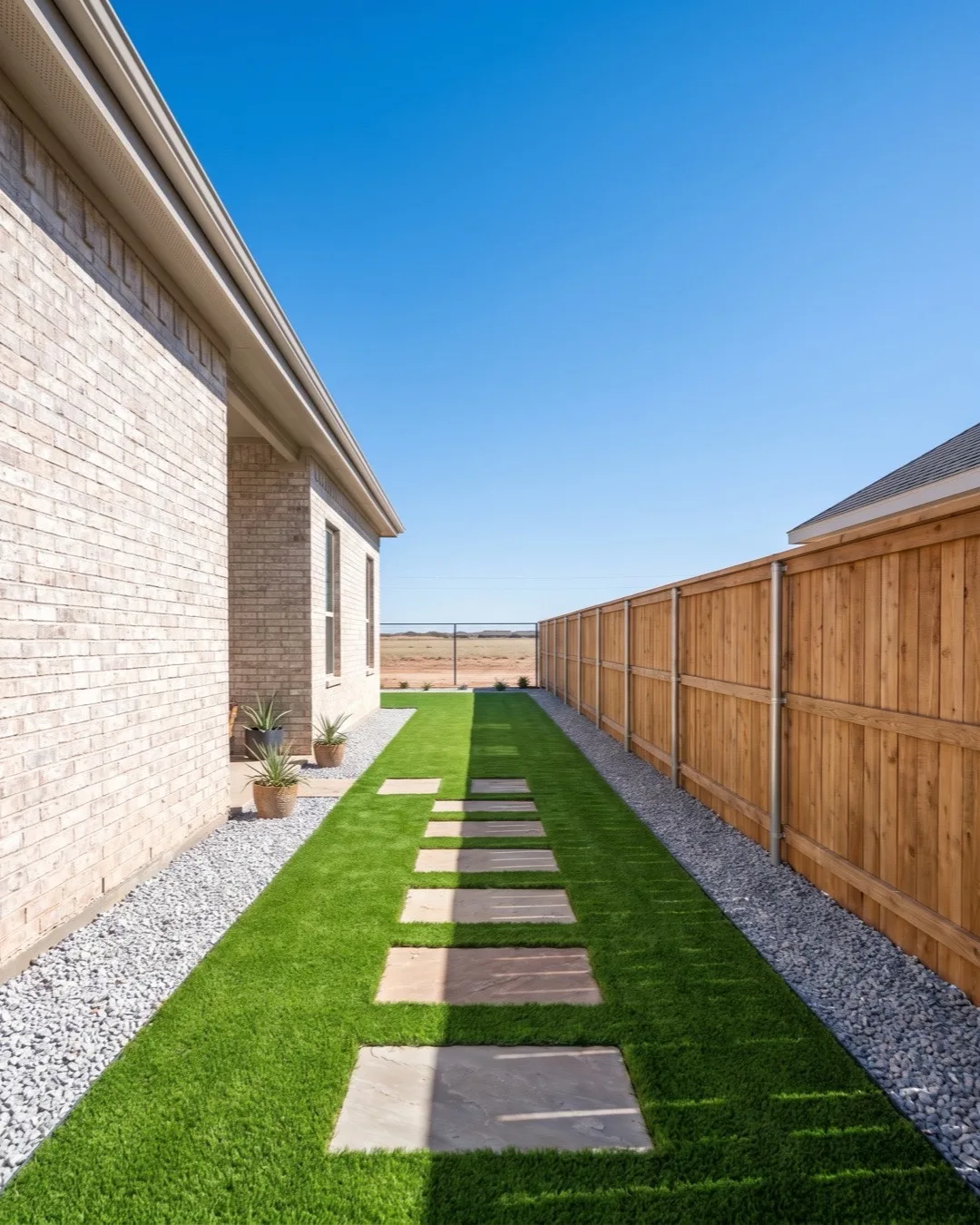
Demolition of the old surface, three to four inches of compacted crushed base, drainage graded away from the house, then landscape-grade turf fastened at every edge and ballasted with infill. Whether the lot fronts Highway 114 or sits a street back, the build sheet is identical, and the maintenance afterward is a stiff broom rather than a mower and a sprinkler timer.
Deciding If a Turf Yard Pays Here
The fair version of the question is not what turf costs per foot, it is what the yard is costing now. Square footage, water use, mowing hours, and how much of the lawn anybody actually walks on all belong in that comparison, and on a small lot the answer sometimes is to convert one zone rather than the whole property.
Split seams, edges that have pulled out of their fastening, matted traffic lanes and low spots that hold water are repairable while the backing is still sound, and repairs are priced by the scope of the fix rather than the size of the yard. If the backing has gone brittle or the base underneath has failed, replacement is the honest answer, and that call is made at the yard.
Pet Runs and Side Strips
Small dedicated zones built with fully perforated backing over a free-draining base and an odor-controlling infill for dogs, or a softer padded fiber for a play corner. Both sit on the same base section as a full lawn, so one can be added to the other later without tearing out what is already down.
Not the build, and that is the point worth making. The base depth, the compaction, the drainage fall, the seaming and the infill rate are the same on a lot here as on a lot in a subdivision closer in, because the things that make a turf lawn last are physical, not geographic. What changes is logistics: a smaller job, a longer drive, and a crew that needs a route in for material.
The climate does the rest of the arguing. This is open High Plains ground at 3,471 feet with no shade to speak of, and the census records no water area at all inside the town limits. A living lawn here is entirely a product of irrigation and mowing, and it still thins out in the lanes that get walked. Synthetic turf holds its color through full sun, drains a hard rain through a perforated backing into a compacted stone base, and has nothing alive in it for a January freeze to kill.
Vetting a Turf Installer From an Opdyke West Address
Ask first whether they will actually drive out for one yard in a town this size, and get that settled before you spend time choosing a product. Then ask what goes under the turf: base depth, base material, and whether it is compacted in lifts. That layer decides whether the lawn is still flat in a decade, and it is the easiest thing for a cheap bid to shave without telling you.
Then ask what the turf is. Face weight, pile height, backing type, whether the backing is fully perforated, and what infill goes down at what rate. A pet run and a front yard should not be getting the same answer. Ask what the written warranty covers on the material and separately on the labor, since those are two different promises.
Finally, look at how the number is built. A measured square footage taken at the property, a per-square-foot price, demolition and haul-off as their own line, and any access premium stated up front instead of appearing later. Two bids written that way can be compared line by line. A quote here is free and carries no obligation, so there is no reason to work from a figure written on the back of a card.
Published national cost ranges put installed artificial turf at roughly $5 to $20 per square foot, with most residential lawns landing between $8 and $14, which puts a typical 500-square-foot yard around $4,000 to $7,000. Pet runs and play zones usually sit in the $10 to $18 band because of the backing, padding or specialty infill they need. Those are national ranges rather than a quote for this town, and they are printed so any bid you receive has something to be measured against.
On a specific lot the number moves for reasons you can see standing in the driveway: how much live sod comes out and gets hauled off, how easily equipment reaches the yard, how much regrading the drainage needs, and which turf grade the space calls for. Knowing roughly how many square feet you want covered, and whether the ground is grass or bare dirt, gets you most of the way to a real number before anyone shows up with a tape.
Wondering what your yard would cost?
Call for a free quote. If the price doesn't work, that's the end of it — no follow-up calls.
Will you really send a crew to a town of 220 people?
Yes. Opdyke West sits on Highway 114 between Levelland and Lubbock and is inside the service area, and a single yard here is quoted on the same terms as an address in town, for a new lawn or for repair work. Quotes are free and there is no obligation.
Some yards here are bare dirt rather than grass. Is that cheaper to turf?
Usually, yes. Bare ground skips the sod demolition and the haul-off that go with it, which are real line items on a quote. The base work, grading and compaction still have to be done properly, so it is a discount rather than a shortcut, and the finished build is identical.
Can you fix turf that another installer put in?
Often. If the backing is sound and the trouble is seams, loose edges or flattened fiber, a repair is the cheaper and more sensible route and gets priced by the scope of the work. If the backing is brittle or the base under it has failed and holds water, replacement is the straight answer, and that gets decided by looking at it up close.
Get a Free Turf Quote in Opdyke West
Send a few details about the yard and you get a call back with a real number. The quote is free and there is no obligation.