
Lubbock Artificial Turf

Free quotes · Brownfield, TX

Artificial Turf in Brownfield, TX: A Yard That Ignores Wind, Sand, and a 17-Inch Rain Year

Call (806) 630-0409

Lubbock Artificial Turf builds synthetic lawns and dog yards for Brownfield, TX, and quotes them free, by the measured square foot, with no obligation attached. Brownfield is the Terry County seat, a title it won by vote on June 28, 1904 by a slim margin over the larger and older town of Gomez, and it is the biggest town on this side of our map: 8,936 people at the 2020 census, down from a peak of 10,286 in 1960. It sits 39 miles southwest of Lubbock at the junction of U.S. Highways 62, 82, 380 and 385 and State Highway 137, which is a lot of highway for one town and part of why it still functions as a real service center.

Cotton is the backbone here, generating roughly 90 percent of Terry County's $63 million in annual agricultural income, with peanuts alongside it and vineyards that have made this the Grape Capital of Texas, a title Governor Greg Abbott proclaimed in 2015. The county grows more than 85 percent of the state's wine grapes across roughly 4,000 acres under vine. All of it drinks. The town overlies the Ogallala Formation, which holds a portion of the Ogallala Aquifer, and county agriculture irrigates something on the order of 144,000 acres from groundwater. Crops earn their water back. A residential lawn kept alive on the same supply is a running cost with nothing to harvest at the end of it.

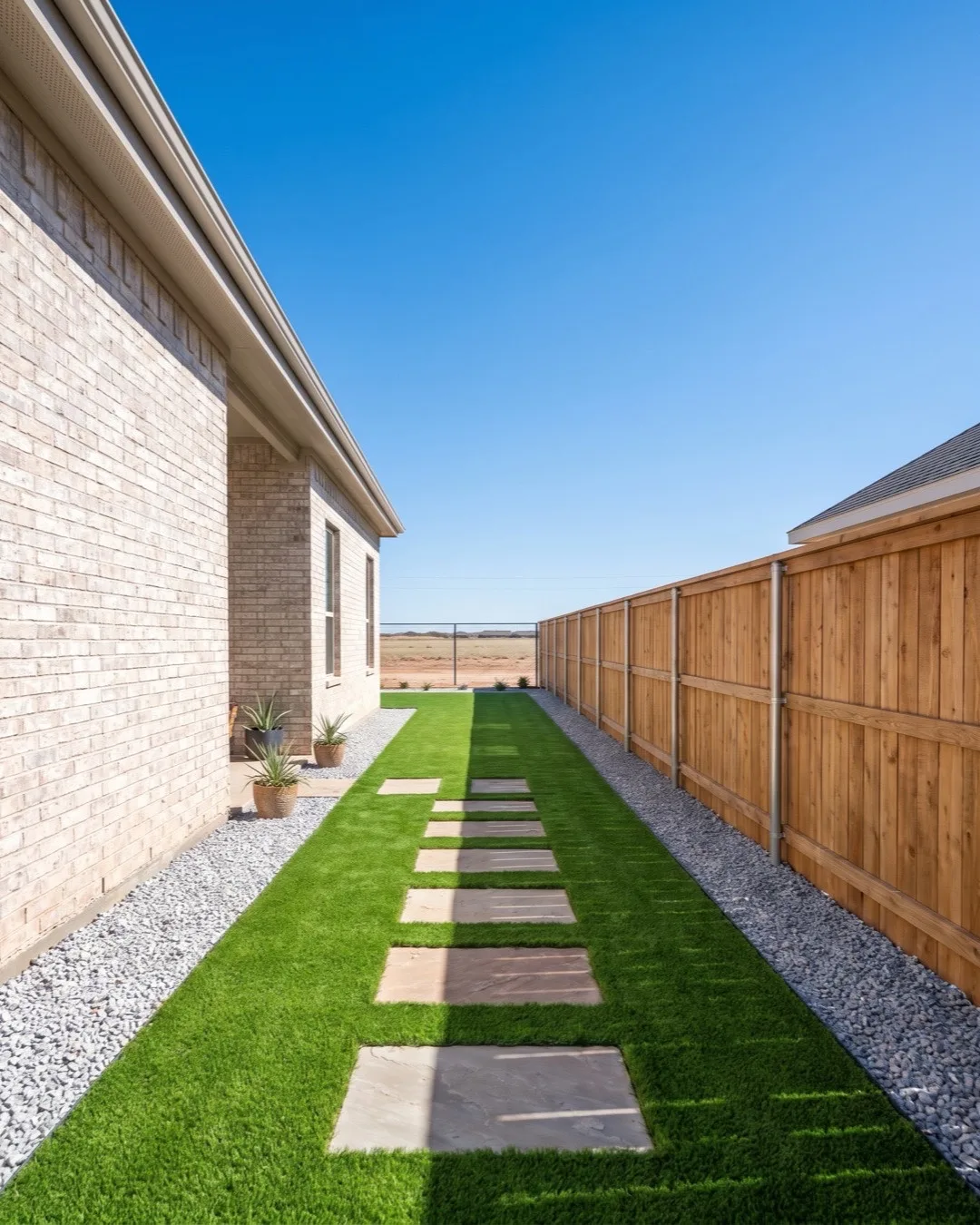
Artificial turf dog run between a wood privacy fence and the house, with a river-rock border

Curious what this runs on a yard your size? Call (806) 630-0409 or get a free quote.

Turf Builds for Brownfield Yards and Dog Runs

Pet Turf & Dog Yards

A dog yard here has to handle a 206-day growing season's worth of heat and a digging dog at the same time. The build is a base compacted with no low spots, a fully perforated backing so urine drains through instead of sitting, and a zeolite or antimicrobial infill that keeps odor down between rinses. No mud tracked in, no bare racetrack worn along the fence line. Pile height stays moderate, because tall fiber mats under paws, and the fastening schedule runs tight, because a dog finds any loose edge first.

How pet turf installation is built

Front Yards on the Older Streets

Brownfield's housing skews mid-century, with 992 units built in the 1950s and 753 in the 1960s out of 3,808 total, and older streets carry front yards that were laid out when water was cheaper than it is now. A turfed front yard holds its color through August, cuts clean to walks and drives, and stops the annual argument between what the front is supposed to look like and where the hose actually gets dragged.

Front yard artificial grass

Full Lawn Conversions

Whole-yard rebuilds on crushed, compacted base graded to drain. Pile height and face weight get matched to the traffic the yard actually sees, then the perimeter is fastened and the fibers ballasted with infill so Terry County wind has nothing to grab. Wear paths carry a denser face weight so traffic lanes age at the same rate as the rest of the yard.

Play Areas and Back-Yard Sport Corners

Brownfield ISD runs Colonial Heights Elementary, Oak Grove Elementary, Brownfield Middle and Brownfield High School, and the city keeps 141 acres of park land across Coleman, Hamilton, Gillham, Jake Geron, Lanny, Fitness and Kiddie Parks plus the Franco softball field. Home play areas get the same idea at yard scale: a foam shock pad under a taller, softer fiber on a free-draining base, so the ground under a trampoline never turns to dirt.

Wondering how this would work at your place? Call (806) 630-0409 or get a free quote.

Sand, Draws, and What Goes Under a Terry County Yard

Terry County is level ground with sandy loam soils broken by draws and playas, and sand hills predominate in the northeastern section. The county has no rivers and no streams at all; drainage runs through draws into the upper Sulphur Springs Creek watershed. Average annual rainfall is 17.21 inches. Brownfield itself sits in a semiarid zone on distinctively red soil.

Sand is the reason base work is not optional here. Turf laid straight onto sandy ground moves, and a surface that moves opens seams and lifts edges within a season or two. The fix is mechanical, not clever: excavate, lay three to four inches of crushed rock, wet it, and plate-compact it in lifts until it drains freely but will not shift underfoot. On the sandier north side of town that base is doing more work than it would on a loam lot, and a bid that specifies base depth in inches is telling you it knows the difference.

The drainage grade matters for the same reason. In a county with no creeks, storm water leaves a yard by soaking in or by running to a low spot, so the grade under a turf yard gets set to carry water away from the slab before the rock ever goes down. Rain that arrives all at once, which is how a 17-inch year usually delivers it, is the condition the base is built for.

Want the square footage measured and priced? Call (806) 630-0409 or get a free quote.

Wind, Heat, and Why the Fastening Schedule Is the Whole Job

Take the local conditions in order. First the wind: a loose edge is how a turf yard fails out here, so every install gets its perimeter mechanically fastened at tight spacing and a full infill drop broomed deep into the fiber. Weight and anchoring are the entire defense, and they work. Second the heat of a long growing season: the fiber is UV-stabilized for the top end of it, and hard freezes at the other end simply do not matter, because nothing in the system is alive to be killed by one.

Then there is the water underneath the town. Brownfield's municipal supply is one of eleven member cities of the Canadian River Municipal Water Authority, which delivers Lake Meredith surface water through the Sanford Dam aqueduct, blended since late 2001 with Ogallala groundwater from the John C. Williams Wellfield. The city also runs its own municipal electric, water, sewer, garbage and street departments, and the South Plains Underground Water Conservation District, created by the Legislature in 1991 to cover some 902 square miles and roughly 150,000 irrigated acres, keeps its district office at 802 Tahoka Road right here in town. Water management is not an abstraction in Brownfield; it is a local address.

Every gallon a sprinkler system does not pull is a gallon that stays in that system. A synthetic lawn needs none at all beyond an occasional rinse of the pet area. In a town whose entire economy grows out of irrigated ground, a green yard with a zero water bill is not a gimmick, it is just the right tool for the job.

Thinking about this part of the yard? Call (806) 630-0409 or get a free quote.

Vetting an Artificial Turf Installer in Brownfield, TX

Brownfield is big enough that you will get more than one bid, which is the best position a homeowner can be in. Use it. Ask each installer three things in writing: what goes under the turf, how the edge is held down, and how much infill goes in per square foot. Base depth and compaction in lifts, a fastened perimeter with galvanized spikes at close spacing, and a named infill rate are the three answers that separate a build from a cover-up. None of them are visible on the finished yard, which is exactly why they get skipped.

Then ask how the number is broken out. A complete quote prices from measured square footage and names the base, the turf backing and face weight, the infill, the fastening, and any demolition and haul-off as separate lines. Anything less is a guess, and guesses grow between the handshake and the invoice. An installer worth hiring will also tell you where turf is the wrong answer, under a leaking gutter line or on ground that has never been graded, and say so before the deposit rather than after.

Two questions are worth asking specifically here. Ask how a bid changes on the sandy north side of town versus a loam lot, because an installer who prices those identically has not walked either one. And if the job is a dog yard, ask which infill they are proposing and why, since odor control in a pet build is a material choice, not a maintenance promise. Quotes are free and there is no obligation.

Want this priced for your yard? Call (806) 630-0409 or get a free quote.

Artificial Turf Cost in Brownfield: What a Quote Includes

National ranges published by cost guides such as Angi and HomeGuide put installed turf at roughly $5 to $20 per square foot, with most residential lawns landing between $8 and $14, which prices a typical 500-square-foot yard around $4,000 to $7,000. Those are the sanity check to hold any Brownfield bid against, including ours. They are not a quote, because a quote requires a measurement and a walk of the actual ground.

Brownfield's pet yards deserve their own line in that math. A dog-ready build runs roughly $10 to $18 per square foot in the national guides, because the flow-through backing, the antimicrobial infill and the dead-flat grade are all upgrades over plain lawn spec. Wind country adds its own line too: tighter spike spacing and a full infill drop belong in the base scope of any bid written for this county, not in an options list at the bottom.

The rest comes down to the lot. With 3,808 housing units, a median build year of 1964 and a median home value of $100,600, established lawns are the norm here, and cutting one out and hauling it off is real work that a bare lot skips. Access is the other lever, since a wide gate keeps machine time down while hand-carrying rock around the side of a house adds hours per ton. Quotes are free, with no obligation attached.

Wondering what your yard would cost?

Call for a free quote. If the price doesn't work, that's the end of it — no follow-up calls.

(806) 630-0409

Brownfield Turf Questions

How far southwest does your service area reach? Is Brownfield inside it?

Brownfield is inside it. The run down from Lubbock is 39 miles on good highway, and a Brownfield address gets quoted like any other on the map. Terry County wind, sand and heat are design inputs for every build down here, so the spec that arrives is already tuned for the county rather than adapted on the fly.

Does a dog yard stay sanitary through a Brownfield summer?

Built correctly, yes. The perforated backing drains liquids straight through to the base, the infill is chosen specifically to control odor, and a hose rinse handles the rest. What makes a pet yard go sour is trapped moisture, and the build is designed so there is nowhere for moisture to be trapped.

My lot is on the sandy side of town. Does that change the install?

It changes the base, which is the part that matters. Sand hills predominate in the northeastern section of Terry County, and sandy ground gives less resistance under load, so the crushed base has to be laid and compacted in lifts to build a stable platform rather than simply filling a hole. Ask any installer how their bid differs between a sandy lot and a loam lot; the answer tells you whether they walked the ground.

The wind out here is serious. What keeps the turf down?

Mechanical fastening and mass. The perimeter is spiked to a secured edge at close intervals, seams are bonded, and the infill load sits down in the fibers as permanent ballast. Turf installed light or left underfilled is what gives the product a bad name in windy country, which is why spike spacing and infill rate are the two things to ask about before anything else.

Get a Free Artificial Turf Quote in Brownfield

Tell us about the yard, the dog run, or both, and you get a call back with a real number. Free quote, no pressure.

Call (806) 630-0409