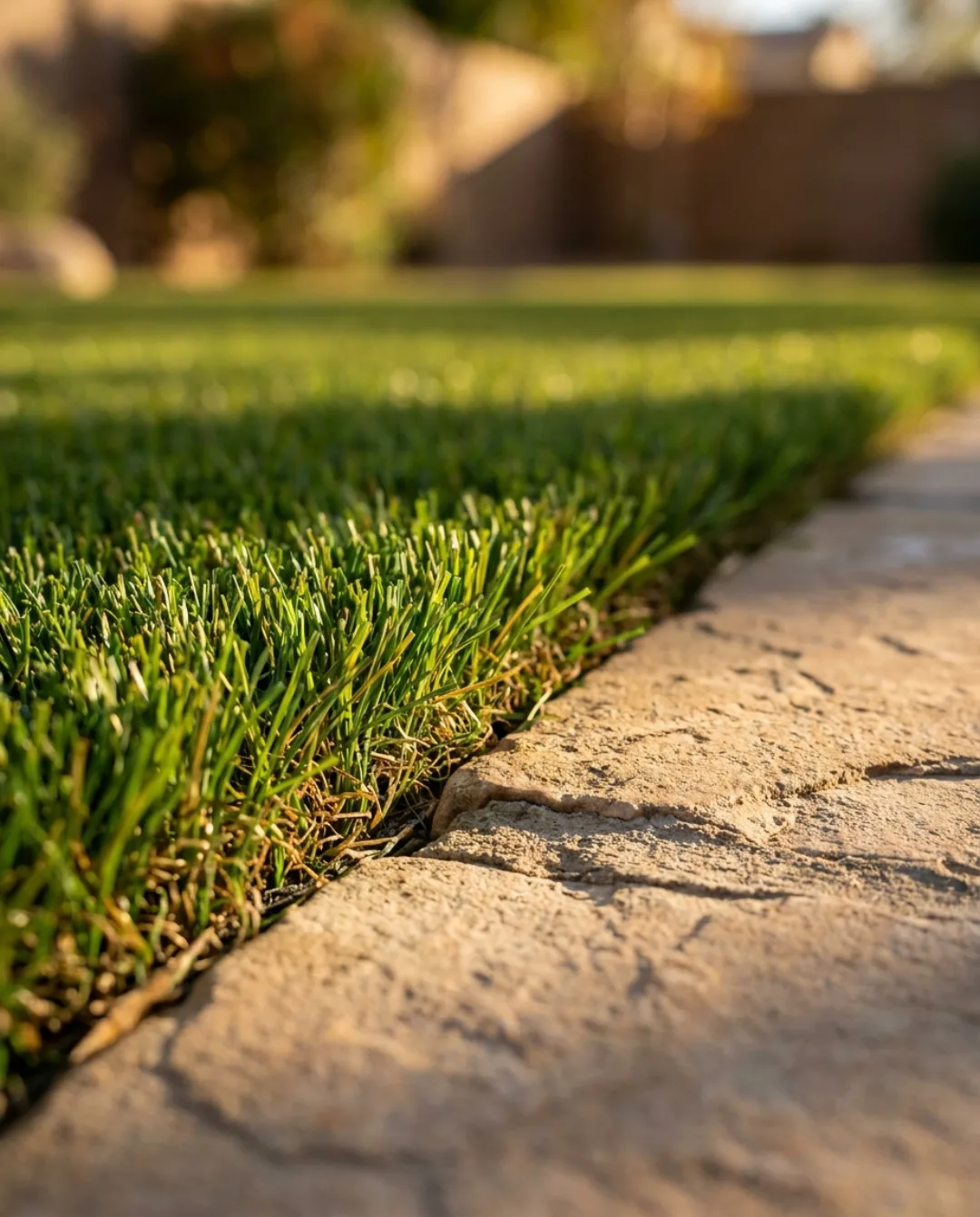
Most turf jobs that fail were lost underground, so judge an installer on the parts you will never see again. Ask what goes beneath the grass; the honest answer is three to four inches of compacted crushed rock in lifts, not turf stapled over scraped dirt. Ask how the edges are secured, because a fastened perimeter with galvanized spikes at close spacing is the whole defense on open plains, and a glued or floating edge works itself free. Ask what infill is used and at what rate per square foot, since infill is the ballast that keeps fibers standing and the surface planted.
Then ask how the number is broken out. A real quote prices by the measured square foot and names the base build, the turf backing and face weight, the infill, the fastening and any demolition and haul-off as separate lines. A price with no scope behind it is a guess, and guesses grow. An installer worth hiring will also talk you out of turf where it does not belong, under a leaking gutter line for instance, until the drainage is fixed first.
Two questions are specific to this town. Ask whether the same spec applies on both sides of the county line, because the answer should be yes and a vague answer tells you the bid came from a template. Then ask what happens if excavation hits caliche shallower than expected on the Lubbock County side, and listen for whether that is priced, allowed for, or ignored. A turf install is a sequence, demolition, grading, base, compaction, seaming, fastening, infill, in that order every time. Quotes are free and there is no obligation.