Lubbock Artificial Turf brings artificial turf installation to New Home, TX on the same terms it offers in the city, priced by the square foot, with free quotes and no obligation. The town sits at the intersection of Farm Roads 211 and 1730, roughly six miles west of U.S. Highway 87 in north central Lynn County, on one square mile of ground at 3,238 feet on the Llano Estacado. The land was once part of the Deuce of Hearts Ranch, opened to settlement in the 1890s, and the community carried that name first; L. G. DePriest suggested New Home instead, because all the homes were new to the people living in them, dugouts included. Farming took hold between 1905 and 1910, a recognizable town formed by the 1930s, and New Home incorporated in 1963.
The 2020 census counted 326 people in 121 households here, 60.3 percent of them married couples, with every resident living in what the census calls a rural area. In plain terms that is a family town with New Home ISD in the middle of it, two campuses and the Leopards, and family yards take a beating. Cotton has carried the local economy the whole way, and the New Home Co-op Gin was processing 12,000 bales a year as of 1985. Synthetic grass holds its color through an entire school year out here without a sprinkler system fighting the climate on its behalf.
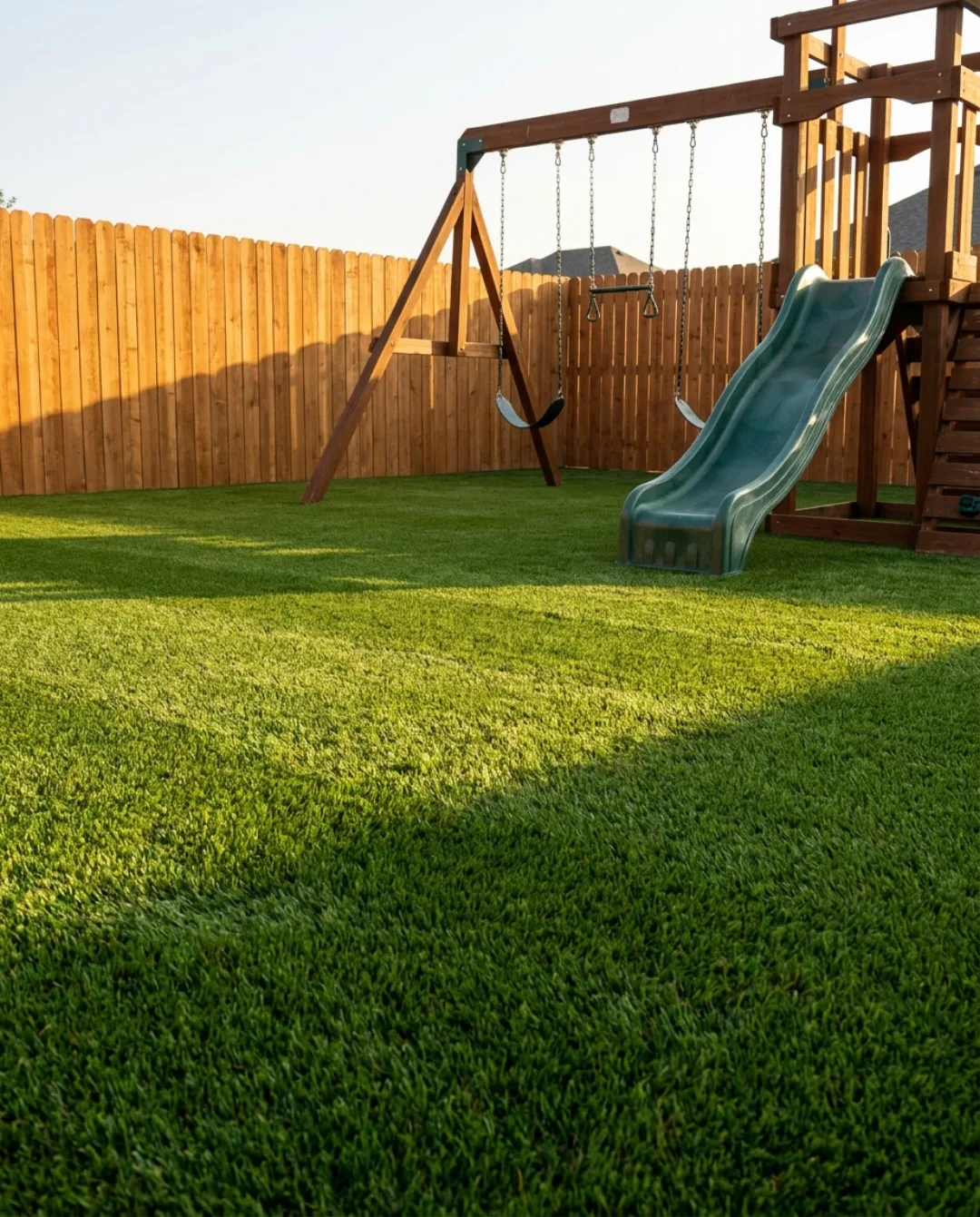
A full lawn conversion built from the ground up: old surface out, crushed base compacted in lifts and graded to drain, turf stretched, seamed, and fastened at the perimeter so wind never gets under an edge. The result is a yard the kids can wear on daily without wearing it out. Face weight gets stepped up for the wear zones, the gate path, the goal mouth, the swing set approach.
Play Areas and Swing-Set Zones
Play surfaces get a softer, taller fiber over a foam shock pad, a build meant for bare knees and falls off the swing set. No mud gets tracked in, no bare patch spreads under the slide, and the surface drains instead of puddling. The shock pad gets thicker as the play structure above it gets taller, which is the same rule schools and parks work from.
Turf Repair on an Older Install
Seams that lifted, an edge the wind found, pile flattened along the path everyone walks, infill washed thin in a corner. Most of that is fixable for a fraction of replacement when the base underneath is still sound, and sorting a surface problem from a base problem is the first step rather than the last. Re-gluing a seam over a base that never drained only postpones the same failure.
Open cotton country puts field dust into every yard in Lynn County. A cleaning visit power brooms the fibers back upright, pulls debris out of the pile, brings the infill back to spec where traffic has thinned it, and treats a pet corner. On a family yard that gets used every day, it is the difference between year-eight turf that still reads as new and turf that looks tired.
A 217-Day Growing Season and Not Enough Rain to Fill It
Lynn County is 915 square miles of almost level terrain dotted with an occasional draw or playa, sitting on the High Plains just west of the Caprock escarpment between 2,650 and 3,300 feet. The soils are sandy loam along with black and gray ground, the native cover is rich prairie grass, and the county's named playas, Double Lakes, Tahoka Lake, Mound Lake on the Terry County line, Twin Lakes, and Guthrie Lake, are where water collects when it finally comes.
The two numbers that decide a lawn here never line up: 17.88 inches of average precipitation against a 217-day growing season. That is more than seven months of growing weather on less than eighteen inches of rain, and the gap gets closed with irrigation or it does not get closed at all. Lynn County lies entirely inside High Plains Underground Water Conservation District No. 1, created in 1951 as the first groundwater conservation district in Texas, over the Ogallala Aquifer, the largest aquifer in the country. Water is not a casual subject in this county, and a lawn is the least defensible thing to spend it on.
The housing stock explains who feels that first. The median New Home house was built around 1974, and 79 of the 107 occupied units are owner-occupied. Those are fifty-year-old yards with sprinkler lines of about the same age underneath them, owned by the people who pay to fix them. A turf conversion ends the whole line of expense in one pass: the lines in the work area get located and capped during demolition, and the surface above never asks for water again.
What to Ask Before Hiring a Turf Installer in New Home
A cotton town knows the difference between a good crop and a good-looking field in June, and turf works the same way: the quality is in what you cannot see from the street. Before you hire anyone, ours or anybody else's crew, ask four things. How deep is the base, and is it compacted in stages or just raked flat? What backing does the turf have, and is it fully perforated so water passes through? What infill goes in, and how much per square foot? And is the price written down by the square foot before work starts?
Weak answers to those questions are how a yard ends up wavy, smelly, or puddled two summers in. A written quote that itemizes base, turf, infill, and labor lets you compare bids on substance instead of on the sales pitch. That is the standard to hold every New Home bid to, ours included.
There is a local wrinkle worth raising too. On open Llano Estacado ground at 3,238 feet, wind and full sun are the two forces that age a turf yard, so ask what the fiber's UV stabilization is rated for and how the perimeter is anchored. An installer who has worked cotton country will answer both without a pause, because out here those two questions decide how the yard looks in year ten.
Start with the published numbers. National guides like HomeGuide and Angi put installed artificial turf around $5 to $20 per square foot, and most residential lawns land in the $8 to $14 band, which prices a typical 500-square-foot yard at roughly $4,000 to $7,000. A play-area build adds a shock pad, and a pet corner adds upgraded backing and infill, so those zones sit higher in the range than plain lawn. Repairs are quoted by scope instead, since a re-seamed edge and a rebuilt corner are different jobs.
A New Home yard moves inside those ranges for specific reasons. Demolition is the big one: pulling out live sod, roots, and a few inches of soil costs more than turfing ground that is already bare. Access is next, since a gate wide enough for equipment saves hours of hand work. And because this is a family town where lots carry real daily traffic, the turf spec itself, pile height and face weight, gets matched to kids and dogs rather than to a brochure photo. Those are the variables that decide where a New Home yard lands inside the range, and quotes are free.
Wondering what your yard would cost?
Call for a free quote. If the price doesn't work, that's the end of it — no follow-up calls.
Does a crew really come out to a town of a few hundred people?
Yes. New Home is inside the service area, and the job runs the same as anywhere, priced by the measured square foot. Town size never changes the terms, and the FM 211 and FM 1730 crossing is an easy run off the U.S. 87 corridor. Quotes are free and there is no obligation.
What should a written turf quote include?
The measured square footage, the turf product and its backing, the base depth, the infill type and amount, edge fastening, and the total broken out per square foot. If a bid is one number on a text message, keep asking questions. Itemized scope is also what keeps the agreement clear, because everyone can see what was promised.
Is turf actually safe under a swing set?
Built correctly, yes. Play-area installs use a padded underlayment for fall softening and a taller, softer fiber up top, with pad thickness chosen for the height of the equipment above it. It is the same idea schools and parks use, scaled to a back yard.
Does turf make sense on a farm lot outside New Home proper?
Yes. Rural addresses around town are inside the service area, and the build is identical: compacted base, fastened perimeter, full infill load. On acreage the usual approach is to turf the living zones around the house rather than the whole property, which keeps the project inside a sensible budget.
Get a Free Artificial Turf Quote in New Home
Send us the basics on the yard and you get a call back with a real number. Free to ask, free to compare, no obligation.