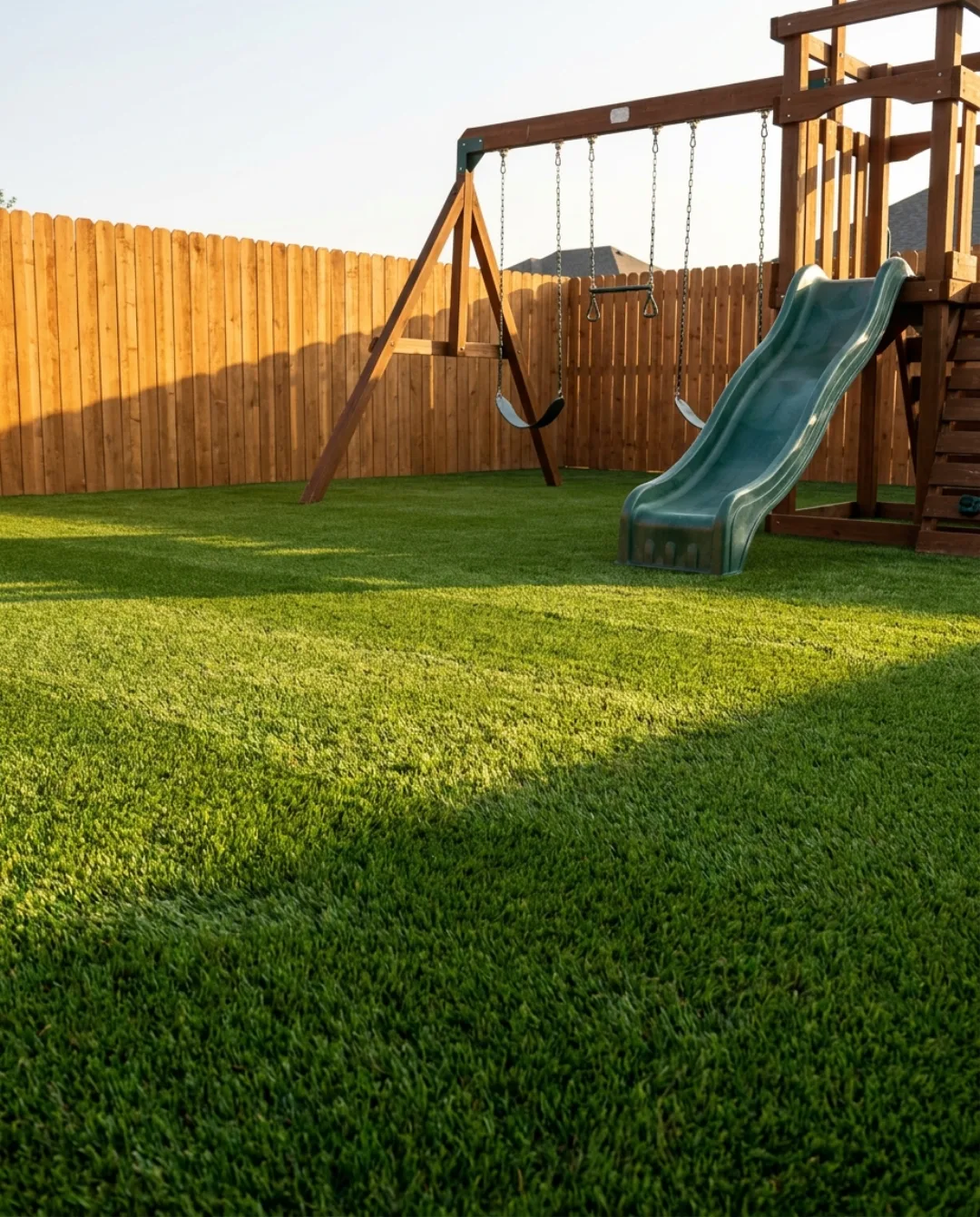
Lubbock Artificial Turf installs athletic turf for home gyms and garage gyms, commercial gym floors, batting cages and pitching lanes, putting and chipping practice areas, bocce and cornhole courts, and backyard multi-sport space. A training surface is a different product from a lawn, built shorter, denser, and flatter, and often over concrete instead of soil. Quotes are free and there is no obligation.
Lubbock pushes training outdoors and then makes it hard to stay there. The climate normals put 92 days a year at 90°F or hotter and 13.3 days at 100°F or hotter, and this is the tenth-windiest city in the United States at an average 12.4 miles per hour, which is why anchored perimeters matter on anything that sits outside. Natural bermuda goes dormant after the first freeze, around November 11, and does not green up again until late March or April, so an outdoor practice area is tan roughly five months a year. Then there are the stickers: goatheads and sandburs are documented invasive problem plants here per Texas A&M AgriLife, and they are two different species, not one. A turf surface has no soil for either of them.
The build changes with the sport. A sled lane and a batting cage floor want different fiber and different infill from a bocce court, and an indoor lane over concrete is a different job from an outdoor pad over a compacted base. Naming the activity first is what makes the rest of the spec fall into place.
Athletic turf runs a shorter pile at a higher stitch density than landscape grass. Tall soft blades feel good barefoot and fold flat under a sled, a bat bag, or a rack. A dense low fiber takes the abrasion, keeps footing predictable, and does not develop a permanent lane where the work happens.
Pad and shock absorption where the load lands
A shock pad under the turf is what changes how a surface feels underfoot and how it handles a dropped load or a fall. Pads are specified by thickness and density, and the right one depends on the sport and the drop involved, so it gets picked deliberately rather than defaulted. Not every training area needs one; a pure sled lane usually does not, a jump or fall zone usually does.
Non-infill turf indoors, infilled turf outside
Indoor lanes over concrete are commonly run as non-infill turf: nothing to scatter across a garage floor, nothing to sweep up, and the density of the fiber does the work the sand would have done. Outdoors, infill still earns its keep as ballast and blade support, especially in wind. Non-infill turf costs more per roll because the fiber has to carry the surface on its own.
Seams placed out of the traffic lane
On a lawn, a seam is a cosmetic decision. On a training surface it is a wear decision. We plan the layout so the seam does not sit under the sled path, the batter's box, the tee, or the walking lane, because that is the line that gets loaded thousands of times. Seams still close on tape and adhesive with the grain running one direction.
Training turf shows up in four settings. Same discipline about fiber, seams, and anchoring; different spec each time.
Home and Garage Gyms
A turf lane down a garage or a strip of the driveway bay, laid over the existing concrete, gives you a sled track, a sprint lane, and somewhere to drop a loaded barbell that is not bare slab. Non-infill turf keeps the floor clean, and the lane gets trimmed to the slab and anchored so it does not creep under load.
Commercial Gym Floors and Studios
Functional-training floors, prowler lanes, and stretch areas in gyms and studios. Higher traffic means heavier face weight, seams planned off the working lanes, and edges detailed to meet rubber flooring or slab without a lip to catch a foot.
Batting Cages and Pitching Lanes
Cage floors and mound-to-plate lanes take concentrated wear in two spots and light wear everywhere else. The build accounts for that with a durable low pile, seams kept out of the lane, and either a base build outdoors or a direct-to-slab install inside a shop or barn.
Courts, Bocce, and Backyard Multi-Sport
Bocce courts, cornhole pads, chipping and putting practice areas, and general multi-sport backyard space, plus turf-surfaced tennis and pickleball style courts where a cushioned, low-glare playing surface is wanted. Court builds live or die on the flatness of the base and the consistency of the infill level, which is what makes a ball behave the same everywhere on the surface.
The five steps mirror a lawn install, but two of them are decided by what happens on the surface rather than by how it looks.
1
Name the sport, then measure
Sled work, hitting, court play, and general floor space all point at different fiber, different infill, and different pad. The activity gets named first, then the area gets measured, because square footage is what the price is built from either way.
2
Decide the substrate: concrete or base
Over an existing slab, the work is cleaning, checking the fall, and confirming the concrete is sound and drains where it should. Over soil, it is the usual excavation and three to four inches of crushed base compacted in lifts and graded. The two paths cost different amounts and are worth separating on the bid.
3
Pad and underlayment go down
Where the sport calls for shock absorption, the pad is laid and seamed as its own layer before any turf. Indoor installs over concrete may also take an underlayment for feel and for moisture. If the surface needs no pad, this step is skipped and the bid should say so.
4
Turf laid, seams placed, perimeter anchored
Rolls are relaxed, laid with the grain one direction, and cut in with seams deliberately routed away from the traffic lane. Outdoors the perimeter fastens to a nailer board or bender board with galvanized spikes; over concrete it is adhered or fastened at the edge so nothing shifts under lateral load.
5
Infill or no infill, broom, and a use test
Outdoor and infilled surfaces get their infill dropped in passes and power-broomed down so the fiber stands and the surface sits firm. Non-infill lanes get broomed and checked flat. Then the surface gets used before it is called finished, a sled pushed, a ball rolled, a lane walked.
What Does Gym and Sports Turf Cost in Lubbock?
The published national cost guides put installed artificial turf at roughly $5 to $20 per square foot overall, with most residential lawn work landing between $8 and $14. Those guides do not break out gym and sports turf as its own category, so we are not going to invent a range for it. The honest anchor is that broad $5 to $20 published band, and the note that training surfaces pull toward the upper part of it whenever a shock pad, a non-infill product, or slab preparation is in the scope.
Those are published national ranges, not a quote. What actually moves a training-surface number is the substrate, whether a pad is required, the fiber spec, and access, a garage lane and a fenced backyard court are different jobs even at the same square footage. Ask for the pad, the turf spec, and the infill named in writing so two bids can be read side by side.
Usually yes, and that is the normal way a garage gym gets done. The slab has to be sound, clean, and dry, and the edges get adhered or fastened so the turf cannot creep when you drive a sled across it. What you do not want is loose turf over concrete held down by furniture, that shifts, wrinkles, and rolls at the edge.
Do I need infill for an indoor gym lane?
Often not. Non-infill turf is made for exactly this: a dense enough fiber that no sand is needed to hold it upright, so nothing tracks across the floor or ends up in the vacuum. The trade-off is cost, non-infill products are priced higher per roll. Outdoors, infill is still doing real work as ballast and blade support.
Will a sled or a dropped barbell wreck it?
A sled will not, on the right product. Athletic fiber is built for abrasion, and a lane laid flat with the seam kept out of the path holds up under repeated passes. Dropped weight is a different question: that is a pad-and-flooring problem, not a turf problem, and heavy lifting platforms usually want rubber or a proper platform rather than turf alone.
Is turf a good floor for a batting cage?
It is the standard for one. The floor takes cleats, dragged bags, and concentrated wear at the plate and the mound end, so a low, dense pile works better than a soft lawn fiber. Build it on a compacted base outdoors or a sound slab indoors, and keep the seams out of the lane between the mound and the plate.
Can the same turf work for a bocce or putting area?
Not the same product, no. Ball roll depends on a short dense surface, a controlled infill level, and a base finished far flatter than a lawn ever needs. Rolling surfaces are their own build. Mixing a court and a gym lane in one yard is normal, it just means two specs and one base crew rather than one product stretched across both.