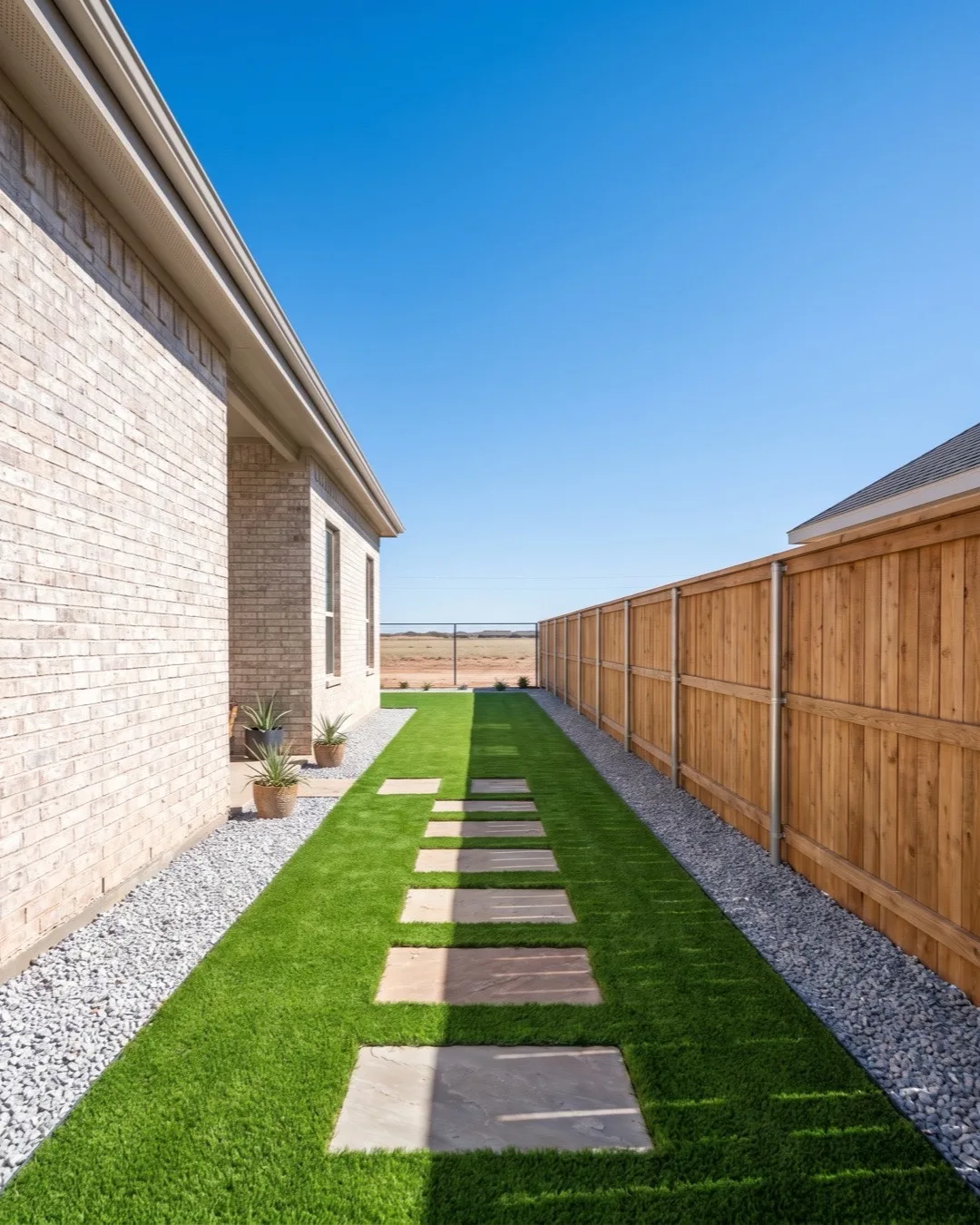
Lubbock Artificial Turf builds artificial grass dog runs: the fenced side yard, the strip along the back fence, the squared-off pen off the garage door. A run is a small job with its own rules. It is narrow, it takes the same paws down the same line every day, and it has to shed liquid along its length instead of across an open lawn. Quotes are free and there is no obligation.
A run in Lubbock almost always lands on the side of the house, which is the hottest, dustiest, most forgotten strip on the lot. The city logs 92 days a year with highs of 90°F or better and 13.3 days over 100°F, so a west-facing side yard bakes. It is also the tenth-windiest city in the United States at an average 12.4 miles per hour, and blowing dirt collects in a narrow run faster than it does in the open. Then there is the weed ordinance, which starts at 8 inches and carries a $200 administrative fee, in the one part of the property nobody walks. Turf answers all three at once, because there is no soil left in the run for anything to grow in.
The build itself is mostly decisions about shape. How much clear width the dog needs to actually move. Where the gate lands, so the traffic path is not also the mud line. Which direction the fall runs down a long narrow footprint. Where the hose ends up, so rinsing takes thirty seconds instead of becoming a chore. Those get settled before anything is dug, because after the base is in they are expensive.
A run gets measured off the dog rather than off whatever strip the house left over. A big dog wants length to move; two dogs want width to pass each other. Below about three feet of clear width a run stops being a run and becomes a walkway, which is worth knowing before it is built rather than after.
Gate and traffic path placed on purpose
Dogs wear a line along the fence and a fan at the gate, every time, in every yard. We put the gate where that line does the least damage, run the turf grain along the path, and spec a denser fiber where the traffic concentrates so it does not flatten into a visible stripe.
Dig-proof perimeter with no lip to start on
Diggers start where they find an edge to hook. The run's perimeter fastens to a nailer board or bender board with galvanized spikes at close spacing, tight along the fence line and under the gate swing, so a claw finds nothing loose to lift.
A rinse point, a gravel border, and stepping stones
A hose bib within reach of the whole run, a river-rock or gravel band along the fence to take splash and keep the line crisp, and stepping stones set flush where people walk. A run that is easy to rinse is a run that actually gets rinsed.
Most runs land in one of four footprints. The turf system underneath is the same in all four; the shape is what changes the drainage plan and the gate.
The Fenced Side-Yard Run
The strip between the privacy fence and the house, gated at one end or both. It is the most common shape because it is space the household was not using anyway, and gating both ends turns a dead-end strip into a loop the dog can work.
Back-Fence Runs Along the Property Line
A long band down the back or side fence, either left open to the yard or fenced off from it. Good for dogs that patrol a line. The fall runs along the length rather than across it, and the turf grain runs with the traffic.
Dedicated Pens Off the Garage or Back Door
A squared-off pen with one gate, sized to the dog and set where the door already opens. Short trip out, short trip back, and the rest of the property stays out of the rotation entirely.
Runs Built Into a Larger Yard Project
A run laid at the same time as a lawn or patio job, sharing one base build and one crew visit. The run gets pet-grade backing and infill, the lawn beside it gets landscape turf, and the two are seamed together like any other transition.
Five steps, the same backbone as any install. The narrow footprint is what changes the emphasis at each one.
1
Walk the run and set the clear width
The strip gets measured, the fence line and the gate swings get checked, and the usable width gets confirmed against the dog that will live in it. The hose bib and the rinse point get located at the same visit.
2
Plan the fall down the length
A narrow run cannot shed sideways the way a lawn does. The grade is planned to fall along its length to a defined exit point, away from the foundation and away from the neighbor's fence line.
3
Demo and base in a tight footprint
Sod and three to four inches of soil come out, usually by hand or with small equipment, because side yards rarely take a loader. Crushed base goes in, wetted and compacted in lifts, worked to the fall line.
4
Pet turf laid, seamed, and locked down
Flow-through backed turf goes down with the grain running along the traffic path, seams close on tape and adhesive, and the perimeter is spiked at close spacing so nothing lifts at the fence or under the gate.
5
Border, stones, infill, and a rinse test
The gravel border and any stepping stones get set, zeolite or antimicrobial infill is power-broomed in at rate, and the finished run is hosed and watched to confirm the water leaves where the grade said it would.
How Much Does a Dog Run Cost in Lubbock?
Pet systems run about $10 to $18 per installed square foot in the published national cost guides, above the $8 to $14 those same guides put on residential lawn turf, because flow-through backing, denser fiber, and odor-control infill each cost more than the lawn-grade version. A run covers a small area, so the total stays modest even at the higher rate.
The catch on small jobs is that the rate per foot runs higher, not lower. Mobilization, demolition setup, and crew time are much the same on a small patch as on one ten times the size, and a side yard with no gate wide enough for a wheelbarrow adds labor on top of that. Those are published national ranges, not a quote. Your number comes from having the run measured.
Wide enough that the dog can turn without brushing both sides, and wide enough for two dogs to pass. Four feet of clear width is comfortable for most dogs, three is workable for a small breed, and under three it is a path rather than a run. For a dog that wants to move, length matters more than width, so a long narrow strip usually beats a short wide one.
Where should the gate go on a dog run?
Where it does not create a bottleneck. Dogs fan out at a gate and wear a line along the fence, so a gate at the end of a run spreads that traffic instead of concentrating it in one corner. Gates at both ends of a side yard let the dog loop, which spreads the wear further still.
Will my dog dig up the edge of the run?
Not if the edge gives them nothing to start on. The perimeter fastens to a nailer board with galvanized spikes at close spacing, tight along the fence and under the gate swing. Most diggers give up when the first attempt finds no lip, and the middle of a run is not where dogs dig.
Does a narrow run drain as well as a full yard?
Only if the fall was planned for the shape. A wide lawn can shed in several directions; a run has one useful direction, down its length. Get that wrong and liquid collects at the low end, which in a dog run is precisely the spot that goes sour. It is the single most important thing to settle before the base goes in.
Can a dog run be added to a yard that already has turf?
Usually yes. The run gets built as its own system with pet backing and pet infill, then seamed into the existing turf where the two meet. An exact color and pile match on older or discontinued turf cannot be promised, so ask to see the closest available product before it goes down.