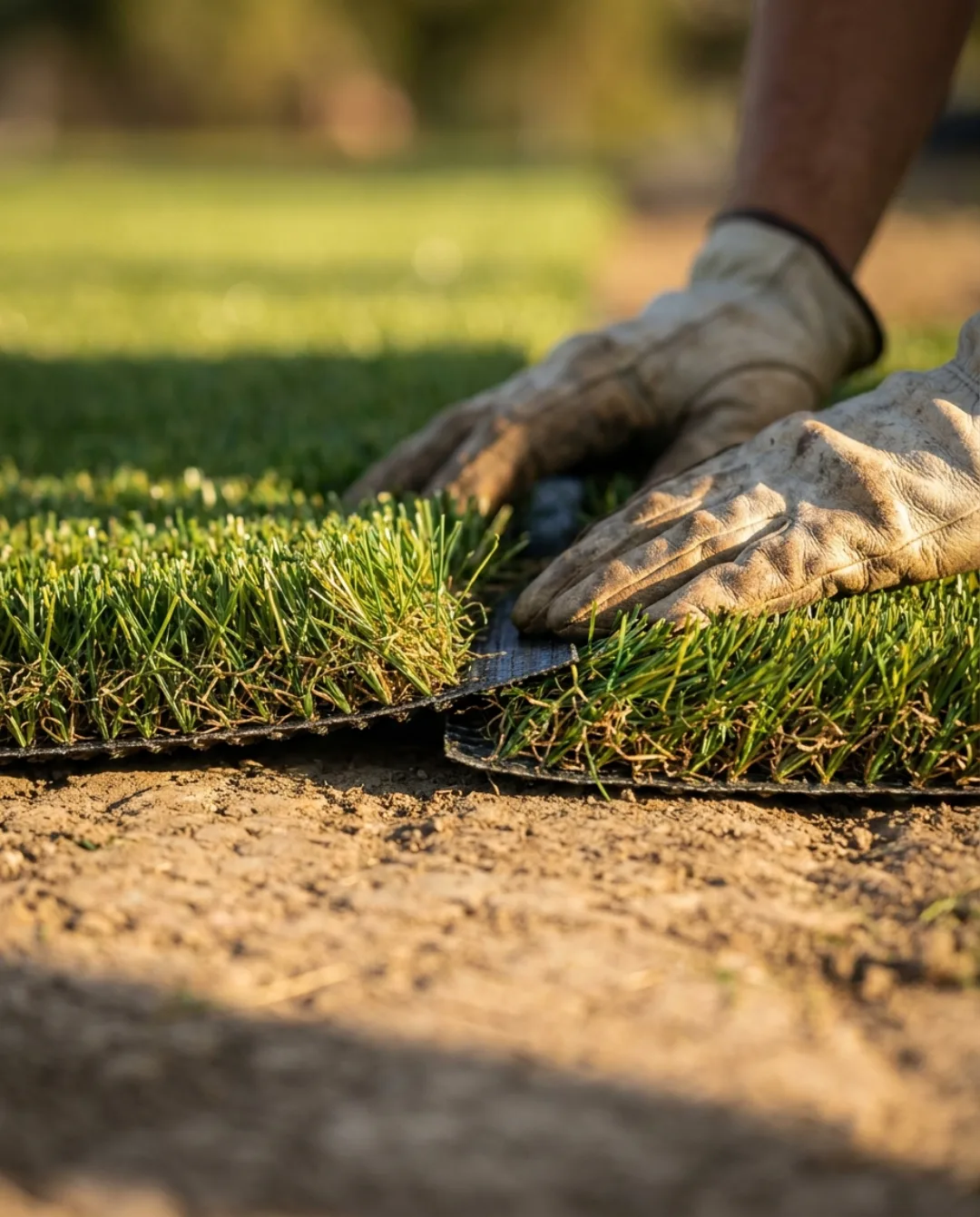
Almost every home here is owner-occupied, 246 of 248, and the median home is from 1961, with the 1950s and 1960s together accounting for 248 of the village's 413 housing units. That combination, long-held homes on older ground, means the people buying turf here are buying it for themselves to live with, not to flip. Buy accordingly: judge an installer on the parts of the job that stay buried, the base and the edges, rather than on the sample in hand.
Ask what goes under the turf and expect an answer in inches of compacted crushed rock, laid in lifts. Ask how the edge is held down and expect galvanized spikes at named spacing into a secured perimeter, not glue into dirt. Ask the infill rate per square foot. Then, because this is a canyon village, ask two more: how the bid changes on a slope, and whether a geotextile layer is included or extra. An installer who has actually built on a graded lake lot will have those answers ready; one who has not will change the subject to turf samples.
Finally, ask for the price broken out by line, base, turf, infill, fastening, demolition and haul-off, against a measured square footage. A number with no scope behind it cannot be compared to anything, which is usually the point of quoting it that way. Quotes are free and there is no obligation, so collecting a second one costs a phone call.